
In today’s automotive industry, many leaders believe the answers to growth are hidden in the latest AI platform, a new dealership marketing strategy, or the next wave of technology promising better results. But the real drivers of success in fixed operations and service departments haven’t changed. Sustainable growth still comes from standards, accountability, leadership, and a long-term commitment to excellence. As fixed ops industry trends continue to evolve and AI reshapes parts of the business, this episode brings the focus back to the fundamentals that power strong fixed operations sales, retention, and long-term dealership performance.
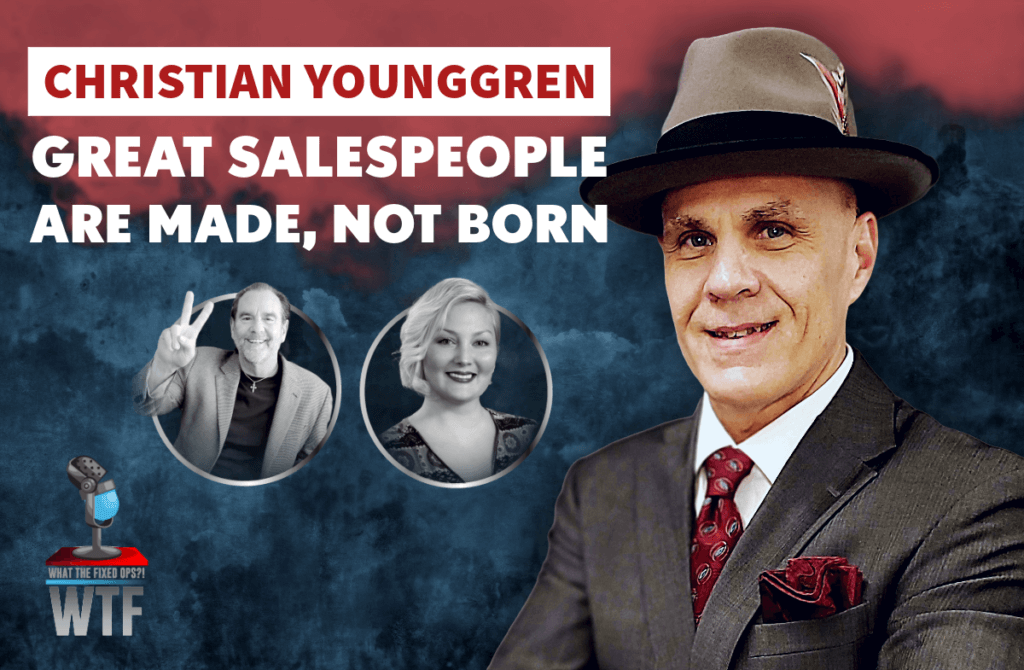
We’re joined by Christian Younggren, an experienced automotive sales trainer and founder of Kaizen Automotive Consulting, who shares his perspective on leadership, training, and the real drivers behind performance in modern dealerships. Christian challenges leaders to rethink how their dealer vendor relationships, compensation structures, and internal expectations influence behavior inside the dealership. His message is clear: culture follows structure. If systems reward shortcuts, shortcuts will define your service department. But when leadership standards, training, and automotive vendor partners align around accountability and customer value, both customers and teams respond.
This conversation also dives deep into automotive service retention and the growing importance of trust in the service lane. Retaining customers in today’s competitive market requires more than a strong fixed operations marketing plan—it requires consistency between the promises made in marketing and the experience delivered in the service department. Real trust in automotive marketing starts with strong leadership, clear processes, and teams that are trained to deliver real value to customers every time they visit.
We also explore the role of Automotive Service Excellence and professional standards in the future of the industry. Certifications, training, and measurable performance standards help build credibility with both customers and technicians, reinforcing a culture that prioritizes quality over shortcuts. As dealerships look toward the future of fixed operations, those that invest in professional development and operational discipline will stand apart in an increasingly competitive marketplace.
Of course, technology and AI are rapidly influencing the future of fixed operations, from diagnostics and communication tools to workflow automation and data analysis. But technology alone won’t fix broken systems. The right tools can support better service operations, but leadership, accountability, and strong automotive vendor partners are what ultimately determine success. Dealerships that build intentional dealer vendor relationships and leverage technology strategically will be best positioned to adapt as fixed ops industry trends continue to shift.
At its core, this episode explores how dealerships can build stronger service departments by combining leadership discipline, smarter fixed operations marketing, better fixed operations sales strategies, and a commitment to long-term customer relationships. As the automotive industry continues to change and AI becomes more integrated into daily operations, the dealerships that prioritize standards, Automotive Service Excellence, and authentic trust in automotive marketing will lead the next chapter of the future of fixed operations.
Read the Transcript
Hello everybody. Welcome to WTF?! Today we have Christian Younggren with us. He is a sales trainer at Kaizen Automotive Consulting. Christian, welcome to the show. Oh thank you. Well, Christian, thank you for joining us today. Why don’t you give our audience just a introduction. Christian Younggren my name. Um, as you said, I got my own company called Kaizen Automotive Consulting. Um, I’ve started in the business. If you back up a little bit, um, in ninety two. So I started in the business in nineteen ninety two, started at a dealership as a sales person, finance sales manager, did that for what, thirteen years. Then in two thousand, I was, um, I was asked by the dealer to attend dealer candidate Academy. Nada Candidate Academy went to that, graduated from there. And then I was the general sales manager at that dealership, Mills Chevrolet in Moline, Illinois. I’ll give him a shout out there actually in Davenport now. Up until twenty eleven, before I decided to get into training. And then that kind of takes me to, to where you’re at now doing training and sales training specifically. But really, I’ve got a couple other modules, disc personality training and the seven principles of influence that, um, there, it’s for the whole entire dealership now. Do you have to have a passion to do sales training? What’s your passion? Where did it come from? It is, it’s interesting you said this. So the passion a lot of times for a lot of people it starts with liking to hear their self talk. They like that. They like to get on stage. You know there’s a there’s in the there’s this I personality, which is the influencer and they’re the, they’re the one that likes to get out there on stage. However, the interesting thing is As I went through my career. I do obviously, you know, you’re going to hear, I like to help people and I do. I like to watch people grow. And here’s the interesting thing. When I flipped and I made my presentations less about me and more about is the audience getting this? Is it sticking? Everybody started telling me how much better of a speaker I was. So, so my passion has turned into just helping people and getting them up. This is a tough biz. There’s a lot of personality styles. There’s a lot of personality styles that this is. They think that this isn’t the right business for them. However, anybody can do this. Good salespeople are made, not born. And so anybody can do this. And I know me being a bit of a ambivert, a little bit of an introvert, when it first came to the car biz, I knew I had to overcome that. And I want to help other people overcome that too, because again, it’s a, it’s a tremendous industry. Yeah. So what separates, you know, sales trainers who are more performative from ones that are effective? What’s the difference? It goes back to information versus transformation. So at NAD, that’s what I spoke on was make training stick and show up daily. And again, information is not transformation. I mean good information, good training. That’s just content. Maybe it’s good entertainment, but nothing’s going to happen until you put it into action. So really knowledge isn’t transformation. Execution is. And that’s the best trainers are the ones that get the people to actually put what they’ve learned into play. You know, I always say there’s this as a manager, I had had two styles that I sometimes would have to adapt, adapt to depending on the person and the situation. Sometimes I had to be a bartender, and I had to let them cry on my shoulder, and I had to listen, and I had to counsel and I had to agree and understand. But then there’s other times I had to be a personal trainer and I’d say, get off your butt and give me some more burpees. Or, you know, in this case, let’s practice this. I want to think about it or track again. I think a good trainer can can find which one he needs to be, or she needs to be at the right time. It’s your strategy. Do you go in and it’s sort of a one time or once a month situation for a period of time. Or do you come in and is, is it like every day for a month? What’s most effective, do you think, to making the training stick with the team? And it’s a great question. So name of my company is Kaizen Kaizen Automotive Consulting. But Kaizen means continuous change or continuous improvement. And so I say one percent continuous improvement a day compounded over a whole year. So one percent say you’re trying to learn a new skill. One percent improvement per day over the whole year will compound to thirty seven times better at that skill. So it’s really, it’s, it’s, it’s, it’s, I always say you got to go Kaizen it, meaning you’ve got to just take it in little steps, little steps go Kaizen it. So if I can, obviously what I’d love to do with the dealer is I’ve got my workshops that are typically two days. The first day is the content, second day a little content. And then we get into doing some actually putting it into action. So really those two days are kind of like, it’s kind of like when I went to football camp, I went to football camp and they taught us these drills and we did these drills for three days. But that three days of doing those drills was not going to get me better. I had to take what they gave me those drills and apply them to do them on my own all summer long, and that’s what was going to get me better. So when I do the two day, it’s kind of like that. However, I always being a person that wants to make sure it makes it stick. And also, I mean, it does help me with my business. And that is I always suggest another option depending on the store, but maybe a ninety day retainer to where I come in and not just do the training, the initial training, I reinforce it with one on ones, one on one training with the salespeople, whether it be Zoom or in person. I found when you can do one on one training, people are different when when they’re amongst their peers. And that’s not really, you know, when you negotiate a car deal, you don’t have the whole dealership watching you and your three sales managers watching you. Typically it’s you and the customer. And so it’s a lot different dynamic dynamic. When you’re doing a role play in front of your three bosses and your whole sales team, right? And so I found salespeople will be much more vulnerable, and it’s much easier to train and coach them up when you’re doing one on one sessions. And, and interestingly, Zoom’s work really well, simply because in those situations, simply because I can record it and it’s just me and them. And then I can take the recording and send it over to their boss. I can, you know, in the middle stop and show them some little lessons here and there. But, you know, to answer the question, that’s really how you make it stick is you got to show up daily. I mean, you have to show up daily. It’s about repetition, um, over a period of time. So my next question for you is what makes a good salesperson? And you said it can be taught. I’ve asked that question of people before and I’ve got mixed answers. It can. It can’t. But what do you think? What makes a good salesperson? What makes them successful? So, um, interesting you say that. So charisma is something that makes a person successful. And you would think, I’ll say that word again. Charisma. Okay. Got it. And you think that charisma is something you’re born with? Hey, he’s born charisma. Hey, you know, and I’ll ask that question in class. I’ll say, hey, what’s charisma? And I get usually the same. I get about ten different answers, twenty different answers depending on how many people in the room. It’s always different, but it’s always kind of the same, right? Susan Fiske, she, I believe was with Harvard University. I could be wrong, but Susan Fiske is a professor, and she had one of the best definitions of charisma that I’ve ever heard. And that is it’s the perfect combination, a perfect balance of trust, warmth and nice warmth and competence. I mean, you want to know somebody that you can trust them and that they’ll be there for you, but you also want to know they know what they’re talking about, right? And, and I think that actually can be taught. I don’t think a lot of people think it can. You’re either born with it or you’re not. I think it can be taught. I think you can. I think you can teach people how to help build trust. And I think you can teach people, obviously the competence. So that’s I think what makes a good salesperson is when there are a combination of that. Right? And then they also know this, this guess needs a little more warmth. I need to go sixty percent more warmth with this gas be forty percent. So they learn how to adapt, right? Um, adapting is huge. I mean, that’s emotional intelligence and you have to adapt to your customers. So you’ve got this, you know, the way you should do it. But by the same token too, based on personality styles, based on the information you’ve got. That’s when it’s okay to maybe go off script a little, right? So that’s what I would, um, what I would tell you. Well, when you walk into a store, Christian, what’s the first sign that the team lacks discipline? What gives you your clues? Just standing at the front door, you know, waiting to waiting to obviously waiting for a guest, right? I mean, just the fact that there’s actually a dope ring that still exists in a dealership, right? The dope ring, you know, the meeting of the minds, that type of thing. Also, I mean, if I don’t, they should be dropping their phone, you know? They should be off the off the phone. Everything stops for a customer. I mean, everything drops and I shouldn’t even see that. But it’s kind of cool when, like, they don’t if I don’t think they saw me and then they drop everything for the customer. I mean, still, I think the customer that it endures you to the customer because they see, hey, he’s attentive, he realizes that he was doing something or she was doing something, but now they need to to be attentive. So that’s usually the first sign. Is that kind of that lack of discipline there? I wouldn’t want more than when I, when I was a general salesman at a dealership, I had this rule two’s company, three’s a crowd. So if there was two of them standing out there, I’d let that happen. But once that third person came up, now you’re going to start forming a dope ring. And I don’t want that. So I’m going to break it up. Now. I would do it in a different, more of a sneaky stealth way. I page everybody up to the sales desk. Needs your help today. You go do balloons. You move that Camaro to the front point. You do this, you know, okay, we’re ready to go. So that way, you know they’re doing something because I found if you are going to be on the lot, you want to be by yourself and you want to be doing something working. You know, it’d be amazing. I’d stand there. There’d be three people standing up as a salesperson. There’d be three people standing up front there watching customers come through. I’d be on the lot, like looking for a like a maybe a switch car for somebody. So I’m out there writing stuff down next to a car, and the customer drives right by those three people and comes over and I’m doing something and they come interrupt me, which is fine. But my point is, is why I didn’t look threatening. You know, I looked like I was actually working and people want to work with people that work, don’t they? I got to the point where like, sometimes I’d see customers walking by and I’d even like act like I was writing. I mean, you know, I mean, like, you just, you need to let them know that you’re, um, you’re there’s nothing wrong. You’re hey, you’re out there to help them. So I think you asked, what’s one of those signs? That’s the sign that I kind of get right away as I first pull in. Um, and then there’s other things, obviously, as things go on, if I’m observing and I watch sales managers not come to greet customers, I mean, immediately they should be doing that. Obviously, the first that initial engagement with the guest, I mean, you look for those types of signs. So I think just everything kind of trickles down from there. Yeah. I’ll tell you, the last thing I damn sure don’t want to do is I don’t want to drive up to three or more people standing out front, you know, waiting for like, their prey or something like that. You know, it’s intimidating as hell. It is. It’s intimidating. In fact, customers, that was like, it was like a twenty year old statistic. But I used to just talk about it all the time. And that was one of their top pet peeves is, is salespeople standing in packs, you know, and you know, what happened when you paged them, right? They thought you were going to turn a lead to them and then you had balloons, right? Yeah, exactly. Yeah. And again, if nothing else, at least they scattered them. Even if they didn’t go do everything, you know, at least they scattered them. But um, yeah, I think that’s, I mean, I think you have to be aware of that. The other one that I hate is when they don’t get up out of their chair, they’re sitting there, and then they reach you from the chair. That’s another bad sign. You can feel that, too. You really can. It just feels, you know. You know. What do you want? It feels like what do you want? Type of deal. So. And yeah. It’s awkward. You feel like you’re interrupting? Yeah. And I tell you, what’s really interesting, too, is I am a, I’m. I’m an early morning guy, but I like to go in dealerships a little bit later sometimes because once in a while, I mean, if they’re super busy, then you can see what kind of. I mean, they should be busy after five, right? But then you can kind of see that once in a while. If they’re not busy, you can go talk to them a little bit. But you know, I kind of like to do that as well and see kind of what the, you know, what it’s like there. But yeah, you’ll, you’ll run into, you’ll run into that laziness at times. So. Well, um, I love to talk to you about influence and I think you’ve written a book on this. You’ve talked a lot about it. What’s the biggest misconception dealers have about influence? So it’s interesting you say that. So there’s seven principles of influence, seven principles of influence. I did not write this book. So the book that I wrote is one chapter they brought in the car guy. I think for credibility because it was a lot of people in like ivory towers and other things that they’re like, let’s get the car guy in here. You bring some street cred. However, I did am a certified influence coach from the Cialdini Institute of Influence, and he wrote a book forty years ago called Influence the Psychology of Persuasion. And so he came up with these seven, actually six influence principles. And he added unity later. And I made up this silly, you know, you talk about learning how to make things stick. Well, one way to do that is come up with acronyms. And if you don’t have an acronym that works, then you make one up. So I made up this fancy French word called Clasher. And Clasher stands for C consistency. That’s one of the principles the L is for the liking. The A is for the authority. One of the S’s is for scarcity, the other S is for social proof, the U is for unity and the R is for reciprocity. So, you know, talking about what I’ve done is actually taken these and it’s kind of nice. I can do that as a workshop for, say, John Deere, but I can also I’ve applied it because of all my years in the car business. How do we use these in the car business? And so I love this actually workshop or masterclass because we sit and I explain what these influence principles are. I go through what the activators are and what the amplifiers are. And then we sit and we have challenges. And so we come up with like ways to use these in the automotive business. And so reciprocity, they all actually have big no no’s, right? So you asked what were some of the biggest mistakes? One of the biggest mistakes is trying to force one of the influence principles. There’s typically one there. You use the one that’s available. So you don’t try to like Trump one up, right? You don’t try to like fake scarcity. You don’t lie about scarcity. If it’s the only car there, then you tell them it’s the only car there. But if it’s not you, you can’t do that. Right? So it’s it’s using them properly. But to give you an example, reciprocity, reciprocity is if I do something nice for you, you feel compelled to do something nice for me, right? It’s kind of this unwritten social contract that we have. And so it’s activated when I make a concession, when I do you a favor or I pay you a compliment. Yeah. Psychological for sure. Yeah. But it’s amplified when that is, it’s unexpected and it’s personalized and customized to you. So for an example, in the automotive business, one thing that we did when we explained this to people, and one of the challenges we had was how do we use it? And so I had sales and I’ve had service advisors talk about this. So I’ll give you the one service since we’re on fixed ops. But the service advisor did was they what they discussed was they had a Keurig. And so they had one of these Keurigs, like a lot of dealerships do. And what she noticed was that this was a gal, she noticed that a lot of her customers came in with Starbucks, with McDonald’s or with Dunkin. And so those were like the three big ones, right? But they served like cheap stuff, right? They, they served the cheap stuff. So what she did was she went out and bought those. And when she noticed the customer in with one of those, like a Starbucks cup or one of those. She she pulled him aside and said, hey, I know we have coffee here, but but you know, I noticed you drink the good stuff. You know, she almost like, whispered to him, hey, I noticed you drink the good stuff so she’d like, show him her personal stash. And she’d go, do you want one of these K pods to go ahead and put put back there? You know, she didn’t have time to always go back there with them. She would if she could, but if nothing else, she gave them that pod and let them go back. So it was you know, it was unexpected. It was. She gave her something right now you can get coffee there. And that’s one of the mistakes is you think that reciprocity is me giving you coffee. If it’s available to everybody, it’s not reciprocity. And then I think that reciprocity is giving you a bottle of water with my dealership name on it, or this little chatzky that’s got my dealership name on. No, that’s advertising. That’s that’s not I’m not giving you a gift. I’m. Advertising is what I’m doing. Plus it’s available to everybody, right? So what she did was she went in and by, by giving them the, the coffee pods that no one else could get. She. She went ahead and gave her something. It was customized and it was unexpected. And that’s how you’re really going to influence people, right? And that’s how you’re going to create relationships. So that’s just one idea of how you can use these influence principles, whether it’s sales or service to go ahead and in this case, create a really strong relationship with your guest. Yeah, I know some, some salespeople that are so good at, I call them deposit deposit deposit withdrawals, but they’re so good at it. It’s almost like second nature to them that just because they’re so complimentary to their guests and notice things out of the ordinary that most people don’t because they pay attention, and when it’s time to make that withdrawal, they it’s pretty easy. Yeah. It’s again, I love that the withdrawals, you know, another one you asked about a mistake. Another one is liking. So liking principal is where I have a tendency to say yes to people when they like us. Okay, duh. I get that right. And a lot of these principles on the surface, I’ll tell them to people and they go, I understand it, but you know what? You guys know what the biggest mistake to liking. Obviously, if we have similarities, if we have things in common, if we do things together, if I pay you compliments, you’re going to like me, right? But you know what the biggest mistake is when it comes to liking? I think I do, but it’s not going to be what you’re going to say, so go ahead. No, it’s thinking that I got to get you to like me. What I really need to do to really activate it, to amplify it, is find a way to like Russell Wright, find a way to like him. And that will that then customers pick up on it. Because think about it, you, you want to be around people that like you and you know, if they like you, you want to be around them a little bit more, even if you don’t like them as much. And I’ll give you an example. When I was in third grade, there was this kid that lived down the street from me, and he knocked on my door all the time. And my mom would say, you should go play with him. He really likes you. And I remember that. Yeah. And I’m like, but you know, over time he knocked enough and I went and did stuff. And she’s right. He liked me so much that I kind of liked him, and it didn’t hurt that he had a ping pong table as well. But still. Still it’s still, it’s still I liked him. Let me tell you about a partner that’s actually helping dealers get ahead. Global dealer solutions. If you’ve been wondering how to use AI the right way in your dealership, especially on the fixed side, these are the people to call. Their team gets it. Not just the tech, but the real challenges that dealerships face every day. We’re talking about conversational AI that doesn’t just respond, it converts it. Books appointments, follows up with service leads, even answers customer questions with actual relevance. It’s not replacing your team. It’s making sure your team can focus on what matters most. Closing rows and building relationships. But GDS isn’t just about AI. They train your staff, drive traffic, and tighten up processes so your results stick long after the tool is turned on and everything they do is built around one goal. growth that is real. If you want more service, traffic, better follow up and a partner that’s always a step ahead. Check them out. Visit dealer.com. Follow them on LinkedIn at GDS dealers, or just shoot them a message and ask, what would you do with my store and see what they come back with? Global dealer solutions. Process driven people first always wanted. Let’s talk about follow up. I’d love to hear your perspective on follow up. What is great follow up actually look like in the dealership today? Personalized. Personalized follow up. So you’ve got to know things about the customer. I mean, you’ve spent a lot of time with them. You know what they. We’re fortunate in the automotive business because we get to ask so many personal questions. I mean, I had a friend that was a manager of a jewelry store. I mean, they can’t, they don’t get too heavily into what they do for livings and those types of things. I mean, a little bit, but you know, the cars, it’s like, we can ask so much personal information about these people. We should know a lot about them where they’re from, you know, past cars, why they grew up, where they grew up, what they do for a living, if they like what they do for a living, if they don’t. So, um, an example of what I call personalized follow up. And, and I think, you know, there’s a guy and I can’t think of the book, but it’s, uh, like enlightened hospitality. And he wrote this book and he was, I think, Danny Meyer’s name. And he’s got some restaurants out in New York and he talks about, I think called like enlightened hospitality, unreasonable hospitality, unreasonable hospitality. Yeah. And it’s like going it’s like going the extra mile. I knew you knew that. Oh, nice. It’s like going the extra extra mile, right? It’s like going the extra extra mile. So I’ll give you an example. We had a salesperson that was working with this guy that was a he was younger, like in his twenties, and he was very proud of himself because he got put on the Illinois transportation team, highway transportation. But his job was to hold the sign. So he gets to hold the sign, right? He’s holding the stop sign because that’s kind of like the first level job. But anyhow, he buys this vehicle and he’d been telling the salesperson how hard it was and how hot it’s been, and they’d had this hot streak going on. Right. And the salesperson sent the, you know what? He’s got to send the thank yous and some of these types of things. But what he really went the extra mile was like about three weeks after the guy bought the car, he went out and found some Gatorade packets and just put them in an envelope and wrote a little note on it, because the customer had been talking about how hot it was. Right? And so he went ahead and he wrote a little note, post-it note on there. And you know, something corny, but you know, hey, hopefully you stay cool when it’s on hot days, that type of thing. That customer became like a dealership groupie. I mean, he like would hang out there for oil changes and that type of thing. And so, I mean, he wasn’t going to another place. So. So that’d be an example. I myself practice what I preach, so I hope so. Pardon. I hope so. Well, and I’ll give you an example. I did it just last week. In fact, I’m going to create a video on it here. I’ve got to put it all together. But I went ahead and we had a dealer. I had a dealer that I’m actually that I met at nada. And we’re discussing maybe doing some training down the road here and there in New York. And we all know what happened in New York, what, two weeks a week ago, they got dumped on hard. Right. And so they had really, really terrible, um, you know, terrible snow, that type of deal. What I did was I went and bought twelve hand warmers down at Menards for five dollars and I put them in a box and I wrote a note in there and said, hey, from one person to another, I know what it’s like, you know, trying to trying to grind during a snowstorm and trying to keep everybody’s heads concentrated in that type of thing. So I didn’t get enough for your whole staff probably here, you know, just a little nod to let you know, I understand from one car guy to another. Give me a call when you get this. I want to make sure it got there right. And I sent it to them. And, um, so I mean, again, does that guarantee me an appointment with this person? No. But I guarantee you one thing. He ain’t gonna forget me. He’s going to remember me. And when I call in there, I may get lucky. I mean, I’ve done similar things like that and they’re like, oh, you’re the guy that sent that, those candies. You’re the guy that sent that book. You’re the guy that sent that thing of, of, uh, Starbucks to us a box of Starbucks. So I, you know, those are, I think the things. I mean, that’s really going extreme, but, you know, if you want to make sure you’re memorable, that’s the type of stuff you do. And you know, and here’s another, another idea. So we talked about the influence principles. And I’m not trying to drag back there, but by the way, a good politician, they always don’t answer the question they were asked. Sometimes they ask to answer the question they wish they were asked. Yes. So anyway, just a little tip sometimes. Yeah. But anyway, so one thing I talk about in follow up is authority. So your sales manager has the authority, right? The sales manager has the authority. And real quick a study that Doctor Cialdini’s team did. So they there’s these real estate agents, a real estate company over in London, and they were having a hard time getting people to, to sign basically to list. And so it was interesting. Doctor Cialdini’s team went over there and they observed obviously like they should. And what they noticed was the receptionist, every time she’d get a call, they’d say, hey, she’d say, what type of real estate are you looking for? Is it commercial? Residential? They’d say one or the other. And then she would actually pick the person that she’d ask what area, and then she’d pick the person in the agency she thought was the best suited for that. And so all Doctor Cialdini’s team did was, hey, why don’t you just tell them this, right? Why don’t you tell them this? So it’s called transferring the authority. So what she would do now when they would call is she’d say, what? What were you looking for? Commercial real estate or residential? They’d say commercial. She’d say, okay. And where’s that? Okay, it’s in the Ashbury area. Okay, here’s what I’m going to do. I’m going to put you over to Russell. Russell is our number one agent in commercial, and he actually happened to just be working with some guests in the Ashby area. So there’s no one that’s going to be better suited to help you. Let me get you right over to him. And so all they nothing was unethical. It’s what Russell really was the expert. She was really doing this anyway. She just transferred that authority over to them. When she did that, it increased contracts, sold contracts, not just, um, sole contracts fifteen point five percent. And that might seem like a lot, but when we’re talking about millions of dollars, it’s a lot of money, right? So you can transfer the authority. So that’s the reason it’s so important to physically when a guest is there to, for the sales manager to transfer that authority. Hey, I’m going to have you work with Russell here. Russell is a S certified. Russell is this or is that you give them your credentials and you know one thing. He’s got an infectious smile. All of our customers like working with him you know. And so it’s that handoff and it’s that manager transferring their authority over to you. And you can actually do it on emails too. I mean, I’ve, we’ve crafted emails to where the sales manager says, hey, I see you’re trying to buy a vehicle remotely from Chicago. I’m going to put, you know, Bill over on this. He is, you know, Nissan certified and he works with a lot of guests on remote deals. So here’s still my number if you need to get Ahold of me. But here is his info. Just another idea. Yeah. People. People don’t know how to do that. A lot of people don’t know how to do that. Yeah. So again, it’s just again transferring that authority over to your salespeople. Well done. Well, Christian, when a dealership struggles with performance, do you think it’s usually process mindset or leadership? Usually it’s leadership. I mean, that’s kind of where you got to kind of start. I mean, typically the fish rots from the head down. Well, I think that’s where I’d start, right? Because that’s typically what it is. And so I’d start there. A lot of times it’s not processes. I mean, it’s people too. I mean, we just aren’t wired to. I mean, we’re just not. I mean, we forget eighty seven percent of the information we take in unless we write it down. So, I mean, we’re going to I mean, some of human nature fails us. Plus, we also defer to this thing called the, the, you know, the law of, of law of least effort. And so, I mean, we were wired to conserve energy, to save energy to, to, to, to be able to go ahead and survive right in the as cave people. So I mean, we always default to the easiest way. And so we have to be intentional not to default to the easiest way. And so I think a lot of times what happens is we go to a training and we get the information and we say, okay, we were trained. No, you, you just got the information. You didn’t transfer that information. Right? And that’s, that’s going to be the whole key. So typically it’s that and there’s no process for, you know, you ask about process. There’s no I said it’s not always process related, it’s the people. But then it’s probably the process for the habit formation. And too many people try to do what everybody does on the first of January. And that is they try to do three months worth of workouts in one workout, and then they get burnt out and they don’t want to do it anymore. And the thought of ever lifting a weight ever again in your life is like, no, right? And so if you would just take little baby steps and Kaizen it, like I said, just Kaizen this thing, man. I mean, Kaizen, this thing. One percent improvement. Um, you know, you’re going to start a YouTube channel. Okay, well, start with today. I’m going to get better sound. You know, that’s how I’m going to work on as my sound. Tomorrow I’m going to work on content and you just and your Kaizen it. So I think that’s what I see at a lot of dealerships is they just don’t have a system put in place, um, to be able to have the information available so they can take it in tiny bite sized pieces and develop the skill in that slower, more intentional way. Yeah, it’s just about getting started right now today, doing something. Exactly. Yeah. I mean, do what you can with what you have, where you’re at, right? Yeah, absolutely. What is one influence principle that could immediately increase CP hours per row? Contrast. I mean, contrast is not really contrast is always available. So, you know, contrast is always available. So for instance, dealerships I know there’s that big Misnomer in service departments, and I like to think that it’s been broken, but I don’t think it really is from listening to a lot of podcasts, and that is that dealers still think we charge for our. It’s not dealers, but customers still think dealers charge like, you know, four hundred dollars for an oil change. I mean, it’s, you know, dealers use variable pricing and, you know, they, they, they, if they’re going to do brain surgery. So if they’re going to do an engine job, they want engine job money, but they’re not going to charge you for a tonsillectomy, the amount they charge you for brain surgery. And they just don’t. It would be bad business. But I think that still that misnomer is there. So contrast principle is just showing. I mean, basically what you do first affects what comes next. So I would take people back to, you know, I would show my customers where the dealerships that have those rates posted. I think that’s a fantastic idea. It’s cool. Some of them are even doing it digitally where they like it says it’s updating in real time, that type of deal. But I think having that contrast showing what, um, the other people are charging versus what you were charging. I think that can that can be one of the principles that I totally agree. Contrast is available all the time. I mean, it’s always available. It’s what you do first. I mean, it’s even sometimes as simple as just, you know, sometimes I’ll tell a dealer, you know, they’ll ask what the pricing is and whatnot. And before I get into it, I’ll go, well, I can’t charge you a million dollars or I can’t charge you one hundred thousand dollars. And even saying that sometimes can affect them. Right? Pause for a minute. I can’t charge you one hundred thousand, but and then you go next. So I think that’s a principle that it’s always available. Sometimes the influence principles aren’t available, but that one’s always available. So that’s what at Christian advisors have ten times the amount of opportunity at building relationships, which is critical because they see so many people or salespeople don’t see so many people. It’s, you know, some of the stuff you’re talking about equally applies, if not even more, to writers because they, I mean, you, you, you have to develop that relationship really quick with them or it is all about the experience and the money. And, you know. It’s like, uh, if you don’t meet their expectations, uh, they’re going to tell. It was a bad experience. They’re going to tell more people about that than they will. A good one. And if you meet their expectations, oh, well, they’re not going to go out of their way. You really have to exceed their expectations. Uh, yeah. Some of it they just expect. I mean, they expect. It’s like from a salesperson, they expect a thank you card. They don’t expect getting Gatorade. But they expect a thank you card. I mean, you’re going to get that you want a fifty thousand, sixty, eighty thousand dollars. Vehicle. You should be able to get that. But you know, you bring up a good point there. I mean. They talk to a lot of people. And I think one of the biggest things we forget is that I mean. They are salespeople. I mean, they really are. They influence again, like you said, more people than. And here’s the thing that they. I think in a sense, they have a harder job because typically people are coming in and not as happy. You’re either. Either spending your time or your money, right? Even if it’s under warranty, you’re spending your time. And if nothing else, you’re spending your money. And sometimes you’re wondering, am I going to spend time and money? I mean, is this going to be covered? Right? I mean, is this covered? That’s one of the million dollar question. So I mean, that’s a difficult thing. Now salespeople have a different one. They’ve got to face that fear. The customer comes in and you’ve got that fear, right. But at least they’re getting something that’s a little more of a positive type of thing too. Whereas the I think so, I think so too. It’s a tough job. I’ve shared this before. Uh, when I was, I used to work at Surf Drive all the time. And it was, I honestly, I don’t even know if it was a service manager, service writer. I think it was a service manager. Uh, but this woman came in, got out of her car. It was a heat case. I mean, it was it was a heat case. She was she came unglued and I watched him operate and what looked like, you know, five, ten minutes was really about forty five seconds. She unleashed on him, and he just stood there, uh, eye contact, make sure the distance was right. Shook his head and didn’t didn’t interrupt her. And it was probably really about B to forty five seconds. And then when she paused to take a breath, he said, I apologize. Will you forgive me? And that was so disarming. In that moment, she started apologizing, had nothing to do with him. It went on and on. It was an amazing display of human empathy. Yeah. He just I mean, sometimes it’s just not I mean, he obviously had skills, but I mean, sometimes it’s just not, um, not throwing any fuel on the fire. I mean, it’s just shutting up anything you want. When, when they want you to engage, you know, they’re, they’re, they’re, they’re in pain. Some something happened somewhere. They’re emotionally distraught and they’re unleashing on the first person they see for whatever reason, whatever the case may be. Actually, I found that those six words are the most powerful words in the human vocabulary. What are they again? I apologize, can you forgive me or will you forgive me? Will you forgive me? I like how you ask because a lot of people say, please forgive me. And it’s like a statement. You’re asking a you made it a question. And I think that’s that makes it different. Will you forgive me? And it requires. It’s a closed question. So it requires a yes or no answer? Yes it does. You know, you can’t be vague with that. And that’s where that’s where the reset came. And the apology started on her side. I mean, it really is about the questions you ask and framing them. And, and I actually spent a probably inordinate amount of time in my fundamentals and beyond class talking about the different types of questions. And I even talk about the basic question of a closed question. There is a time you do want to ask a closed question because you want just a yes or no answer. So no, I think that’s fantastic. Um, again, it’s, it’s not an easy job out there. No, no it certainly isn’t. Um, well, you know, Christian, you’re an Ada speaker and an author. What message do you feel the industry needs to hear most right now? Well, I think that right now we need to close the gap from what we say we do and what we really do. So if you listen to like certain people talk, you’ll listen to somebody maybe on an interview and you would think that the automotive business is right there in the twenty first century. You know, with the remote deliveries and all that type of thing. But if you go into most dealerships like I do and like you guys do, it’s not the case. So I mean, it’s like we talk a pretty good game when we’re publicly we know that, you know, CNN might pick this up or a big podcast might pick this up. So it’s really, you know, it’s, it’s really meeting the customer where they want to be met. And we still, you know, want to cling to these old school type things. But I think we’ve got to get to the point here where we understand that, again, we’ve got to meet them where they want to be met. And I think that’s one of the biggest mistakes. The other thing is I think adapting to your customers. I mean, I talked about that emotional intelligence element. I think you’re going to see more and more of that coming in training at dealerships. You’ve got the disc personality style training. Just understanding personality styles is going to help you. But that doesn’t um, that doesn’t equal emotional intelligence. No. So I think, you know, emotional intelligence. And so in disc training, we talk about the platinum rule. You’ve got the golden rule, which you guys know the golden rule, right? And it’s not those that have the gold make the rules, although that’s the one. Yeah. Wait a minute. The golden rule. Let me I want to do to you what you just did to me or something like that. Do unto others as you want done unto you. Right? Right. That’s exactly right. It’s totally wrong when it comes to disc, when it comes to the personality styles, you treat others the way they want to get treated, right, and you adapt to their style. Does that mean that you give in and you still you take no for an answer? No. But it means you adapt to that style. I mean, you know, getting the belly bucking contest with a certain personality style is, is, you know, an s personality style, which is a little bit softer, a little slower paced, a little bit more people oriented is not going to work. Now, it may in some cases with certain personalities. Does it possibly could. So again, I think it’s it’s being more emotionally intelligent. So we can meet the guests where they want to be met. And last but not least is time. I mean, our most precious commodity is time. Our most valuable asset is time. We can’t get anything back. We can’t get it back. It’s something that makes us all we all have in common. but it’s also something that separates us because we all use that same amount differently. We all don’t know when that time is going to be up, but all of us will someday not have that time anymore. Making it again the most precious commodity we have in all the stuff that you do, all the training, the influencing, the psychology, etc.. And now you may have approached this during my camera debacle, but what about body language and mirroring the customer? Oh, I mean fifty five percent of emotional communication, we get that fifty five percent of emotional communication is body language, thirty eight percent is tone and voice inflection, and seven percent is words. So mirroring I do like I think it’s difficult at times with mirroring. I think it’s time because you’re trying to think, what should I be doing? What should I be? Should I be doing the exact same thing as you? Um, I do, I mean, there’s something called mirror neurons. That’s actually a real thing that we learn from watching other people do things. So I think it’s more of an advanced technique. But yes, I think we need to be cognizant of it. The first thing I try to do is just get people to read them. Right. And then, you know, Vanessa Van Edwards has got a fantastic book called cues, and she talks about some different principles. She talks about in their hands how important it is the hands to be showing your hands, to make sure that people see your hands. And it kind of goes back to, you know, back to shaking hands. I mean, one of the reasons we shake hands is to show you don’t have a gun in your pocket. Well, yeah, absolutely. And there’s a right way to shake hands. Exactly. Over under equal. Too hard, too soft. There’s so many, uh, psychological things that you’d want to mirror your customer on that, right? But be careful, because if you give me a death grip, I’m probably not going to go death grip back, but I’m going to go a little harder than normal. You know what I mean? I’m going to if you’re going to do a death grip to me, I’m going to go a little harder. So I definitely think, yeah, but right away, you know that right away. You know, that death grip, there’s, uh, there’s some overcompensation somewhere in there. Oh yeah. When they, when they, when they try to go over your wrist, which isn’t hard for me because I got, when they go over your wrist, then you know you’re really in trouble. Yeah, right. True. Christian, if a dealer is listening today and feeling really stuck. What’s the first action they should take in the next twenty four hours? First thing is, you don’t react, you research and, you know, they say data. You know, I mean, you want to use your data. So if it’s, for instance, follow up, I’m going to say, number one, I got to figure out what my problems are. I got to identify my problems before I go, um, and start trying to do training. What is my initial problem? So I’m going to start probably with looking at the data. I’m going to ask myself, is it dirty data? Is it clean data? I’m going to look at the data and then I’m going to use that as kind of my guide. Is it that we’re just not sending out things on time? Is our is our is it our response rate or is it our content? Is it a combination of both? So I think I’m going to just try to identify where the problem is. And my hope is that we’ve trained everybody properly to enter this stuff in. And we at least can glean some type of decisions from that data rather than just I mean, yes, I get it, action is important, but action with no intention is just activity and you’re not getting any results. Good stuff. Listen, I have read your story in here and a couple of the others as well. And I’ve gotten to know you over the last couple of few years in different rooms and stuff and different engagements and so on. And I’ve heard and understand your story and you know, what happened, where you came from. What I wanted to ask you, was there was there something that happened when you had an aha moment or the light came on or somebody came into your life, or you hit a particular brick wall that you know that. Is there anything like that where things changed for Christian and what that was that you can share with somebody? For me, it was the death of my mother. So my mother and I were extremely close. She was married and divorced three times. She raised me. So I mean, you know, shout out to mothers. So very difficult when she passed away. I was in the dealership for twenty years. She did roughly not quite, just shy of twenty years. And her and I constantly talked. We talked a couple times a week, half an hour talk. I was a mama’s boy. Okay, so I’m a mama’s boy. And the one thing she really kept encouraging me is like, because I kept saying, I want to do twenty years and then I’m going to go do the training thing. And she kept saying, you should go now. You should do it now. You can train now. She sold real excuse me? My father sold real estate. She sold insurance. And she’s like, we have insurance trainers come in and they’re not half of what you could be. You know, this, that and the other. So turning point was when she passed away. When she passed away, I did what they say you should never do. And that is I quit a twenty year job where I had two guys that were twenty years my senior, and I was going to be plum to be running the place and and, you know, all this type of stuff. And I went ahead and said, I’m going to do what I really want to do. Um, you know, not so much honoring my mother. It’s just honoring her word and knowing that she, her intuition always guided me and she was always right. So I went in and did that. I mean, I walked past some money to go do this for a while, but it’s what I really want to do. And I could go do a lot of different things at a dealership, but this is really what I want to do. So so that was the turning point. Like I said, I did what they said you should never do, but I did it with calmness and I did it with this feeling of, wow, I didn’t I knew the magnitude of what I was doing. I felt this calmness and this presence that I was going to be okay. And I know it was her looking over my shoulder and she still is. Yeah, absolutely. You just stepped right on out, didn’t you? Yeah, yeah, that’s what you gotta do. I struggled, I mean, like anybody, you know, I mean I struggled, I didn’t you know what I didn’t know and that’s one of the reasons why, you know, shout out to the APA. I mean the a p a I, I didn’t know I was a good trainer. I was good in front of people. I was a good speaker, all that. But I didn’t know crap about the, about the training business. I mean, I didn’t know crap about running a training business. Do I charge but but you know about people, correct. But I had to learn all that. And so that’s where, you know, standing up on shoulders of people like yourselves that have had companies for a while and could go, no, you need to look at it this way. And you look at it that way. So that’s been, you know, extremely helpful as well, um, going out on your own. But yeah, you just got to go out there and make mistakes and see what happens, right? I mean, what is it the, the y you know, I like this, the saying and that is I never, I either win or I learn, I never lose, you know, I win or I learn I never lose. So I try to tell myself that all the time when I walk out and they say, no, I walk right out of the dealership and I go, well, you know, what did I learn? And so I stop and ask myself what I learned. I think that’s great because no, really, most of the time doesn’t mean no, it just means next opportunity or no, I don’t have enough information to get a yes or whatever it is. And it’s important that we examine that kind of stuff. And you strike me as the person that does that and teaches that as well. Yeah, sometimes to nauseam. But yeah, I analyze stuff backwards and forwards and each way. And then there’s a certain point where I finally say, are you trying to control what you can’t control? Youngren. And then when I say, yeah, you’re trying to control what you can’t control, then I back off. So you, you’ve learned quickly to let go and move. Uh, or do you just, I mean, I struggle with I struggle with it still. Yeah, I struggle with it still. I mean, I really do because it’s so satisfying to, you know, bring in that prospect from two years that like, slammed the door on you and now you totally flipped it. Right. And I mean, I don’t know, it’s just, it’s satisfying. But if you listen, if I’m, if you really went and asked yourself, is that the best use of your time? Maybe, maybe not, but I don’t know. It’s not, it isn’t. Money’s nice, but it’s not always about money. Sometimes it’s about what how I feel. At the end of the day, that’s really probably what’s the most important. No, I think if it is solely about the money, um, I just have my own thoughts on that. It’s counterproductive. The money comes as a byproduct of whatever service or value that you’re pouring into other people, and how you give of yourself. I really believe that. Not to say somebody might not already know it’s all about the money. And then I look at their life on the inside and I don’t want that money. Yeah, yeah. I mean, I’ve had opportunities to do things, you know, real estate and I’ve got some rental properties and whatnot. And I’ve had some opportunities to where like I had inside knowledge from friends that I could have went and bought land underneath them. And I just like I told him, I would never, you know, we had a falling out for a little while and I’m like, why? They’re like, what scares you might go buy that land. And I’m like, I would never do that. I know legally I could have and it would have been okay. But that’s just not the that’s not the point. And that’s not the point anyway. Absolutely. I wouldn’t be able to look at myself in the mirror. Well, that’s why you have the reputation, uh, that you have. Uh, people admire and respect your tenacity and your relentless pursuit of what you do. Yeah. And, but let’s, let’s let it. I’m a work in progress and we all are. So let’s I mean, let’s let’s have that clear. I’ve got my flaws and I know some of them. Some of them I don’t. But I’m I’m trying I’m trying to be a little bit better, one percent better today than I was yesterday. And tomorrow one percent better. There you go. Yeah. Well, we’ve had a great conversation today, Christian, and we’ll have to have you back to talk more. Fantastic. I’d love to come back despite all of our technical difficulties. So the the final question I’d like to ask you today is, are there any questions or anything that we didn’t talk about today that you wish we had? That’s always one of my favorite questions to ask. What was the question I should have asked you guys that I did not ask? Without getting into anything lengthy, I mean, you know, we did hit all the we did hit the things that I wanted to hit. Like I said, you know, the fundamentals, you got to have first fundamentals. But I think understanding people is going to help you a lot. The disc personality training, whether you did it with me, whether you do somebody else’s type of personality training, do some personality type of training, I think that’s going to really help you with today’s customer. And then these seven principles of influence. If you haven’t ever read the book influenced by Doctor Cialdini, it’s a forty year old book. It’s the only book I ever read in college that I didn’t have to read. I mean, it’s the only book I ever read. In fact, I was it was sitting there and these I was in this dorm room and these dudes were smoking pot before they went to the to the cafeteria. And I’m like, I start reading the book and I’m like, can I have this? And he’s like, yeah, I’m done with it. And like I said, it’s the only book I’ve ever read. So I think understanding people, I think understanding the psychology behind some of this is extremely important. Yeah. And obviously, whether it’s me or anybody, I think that everybody can benefit from a coach. I mean, I really do. I really started I had two coaches helping me with the nada. It’s there’s nothing wrong with that. You know, it’s interesting. I’ll go to managers and a coach, you know, I’m a manager and everybody can use a coach. Everybody. And yeah, I don’t care if it’s finances, relationships or prepping for a nada, a total freak out. Anxiety meltdown before you get up on stage. I mean, wow. So listen, I told you this, but it is a it is a an honor. And, uh, we’re humbled, honored and grateful to have had you on. Also your book, uh, you know, uh, everybody get out there and, uh, get it. Uh, I happen to, you know, he handed it to me at nada. He is now, uh, not only an author, published author, but he’s also nada workshop speaker extraordinaire and, uh, very talented at what he does. And this is, uh, thank you so much. Another successful episode of WTF. And that’s what the fixed ops to everybody out there. Charity, thank you for all that you do. Thank you, Christian for coming. We appreciate it. Thank you, I appreciate it. Thank you. Thank you so much. Absolutely. Like him. Love him. Reach out to him. Comment. Ask him to talk to you. Invite him into your store and see what he’s all about. Uh, you’ll be happy that you did.
Watch or Listen