In today’s evolving automotive landscape, dealerships that rely solely on vehicle sales are leaving significant revenue opportunities untapped. Industry leaders like Tim Pohanka emphasize that long-term success is rooted in one critical area: fixed operations, commonly known as Fixed Ops. What was once considered a backend function has become the foundation of sustainable dealership growth, encompassing service, parts, customer retention, and even AI-driven communication strategies.
Over the past decade, the rising cost of new vehicles has shifted consumer behavior dramatically. With average transaction prices climbing from around $26,000 to over $46,000 in just a few years, more customers are choosing to hold onto their vehicles longer. Today, the average vehicle on the road is over 12 years old. This shift creates a powerful opportunity for dealerships to focus on car maintenance services, increase customer lifetime value, and build stronger service relationships. Instead of relying solely on new and used car sales, successful dealerships are prioritizing service retention strategies that keep customers coming back.
Fixed Ops stands out because it offers a level of predictability that vehicle sales simply cannot match. While sales fluctuate with market trends, service departments operate on consistent demand. When structured correctly, fixed operations become a data-driven system that generates recurring revenue through repeat visits, measurable performance metrics, and scalable processes. This is why many experts describe Fixed Ops as a science. With the right pricing strategies, inspection processes, and service workflows in place, dealerships can forecast revenue and grow with confidence.
One of the biggest mistakes dealerships make within their service departments is over-quoting repairs. When customers are presented with large repair estimates, often exceeding $2,000, approval rates drop significantly. On the other hand, when service advisors present accurate and realistic recommendations, customers are more likely to say yes. Smaller, properly explained repair orders build trust and lead to long-term retention. The goal should not be to maximize a single visit, but to create a consistent and positive experience that keeps customers returning over time.
Simple services like tires, brakes, and wheel alignments are often overlooked, yet they play a critical role in customer retention and service department profitability. Many customers don’t even realize that dealerships offer tire services, which represents a major missed opportunity. These essential services not only drive immediate revenue but also lead to additional work such as alignments and future maintenance. Customers who purchase tires or complete routine maintenance at a dealership are far more likely to return for future service and even purchase their next vehicle there.
Customer experience has become a defining factor in the success of any dealership service department. Modern consumers expect transparency, communication, and convenience. Setting clear expectations, providing timely updates, and offering solutions such as loaner vehicles or rideshare options can significantly improve satisfaction. One of the most impactful tools in recent years has been video multi-point inspections (MPI), which allow customers to visually see what repairs are needed. This level of transparency builds trust and removes uncertainty, making customers more confident in approving recommended work.
Artificial intelligence is also transforming how dealerships communicate with their customers. AI tools can simplify complex automotive explanations, making it easier for customers to understand what repairs are needed and why. In addition, AI enables dealerships to send personalized, data-driven messages based on driving habits, mileage, and service history. Instead of sending generic coupons, dealerships can now provide timely, relevant information such as notifying a customer when they may soon need new tires. This shift toward educational and personalized communication improves engagement and increases conversion rates.
Another evolving strategy within fixed operations is rethinking the traditional appointment model. Some dealerships are moving away from strict appointment scheduling, recognizing that vehicle issues don’t happen on a set schedule. By allowing more flexibility and adopting a “no appointment necessary” approach, service departments can increase workflow, improve technician productivity, and better meet customer needs. This approach requires strong communication and process management, but when executed correctly, it can lead to higher efficiency and greater customer satisfaction.
Ultimately, the future of dealership success lies in fully embracing the potential of fixed operations. Dealerships that invest in service department processes, leverage AI and data, prioritize customer communication, and focus on long-term relationships will stand out in an increasingly competitive market. Fixed Ops is no longer just a support function—it is the core driver of profitability, customer retention, and long-term growth in the automotive industry.
Read the Transcript
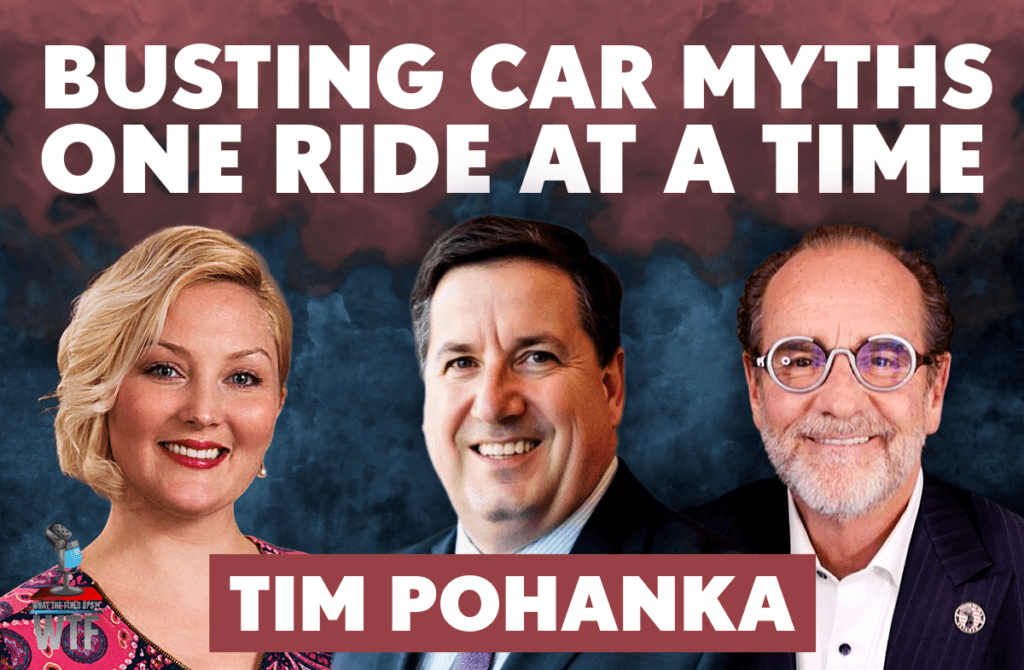
Hello everybody. This is your host, Russell Hill. And this is an episode of WTF. And that is what the fixed ops to all of you out there. And I’m joined today by. Hello everyone. I’m Charity Dunning, the co-host here today and we’re really excited. We have tempo Henka. He is the VP and COO of Pohanka, Nissan, Hyundai and host of tour de tours. Um, Tim, you got to start us off. You got to start by telling us about tour de tours and what you’re doing over there. It’s amazing to be here. I’m super excited. Anytime I get to talk fixed ops, I get excited about it. So thank you. On that tour de tours is a fun little program we started last year. Um, it’s three car dealers Taking old cars out to talk about the myths around them and see if we can get them to actually show up. We did one last year with Nissan and CVS, and it took off and became somewhat of a little minor hit and got the attention of some, uh, some talented people in broadcast. And they asked us to, uh, to keep it going. And so we are. Yeah. Well, you’re maybe being a little bashful because it, it minor hit is a little bit of an understatement, right? I mean, anytime you find out later that you’re going to be on, uh, a streaming service and then they’re going to put it on another streaming service. I mean, yeah, I mean, the words Apple and Amazon do have a fun ring to it. So yeah, they do. Absolutely. So let me ask you, at what point did you go from like, cool idea to like, uh, we’re actually doing this, you know, uh, you know, it was, it’s actually pretty funny. Our marketing team here, latitude that handles all our socials said to me, hey, you know, we want to do some storytelling and what, what, what, what do you think we can do? And they shared with me what other dealers were doing. And I’m like, yeah, but they don’t really talk about the dealership. They’re fun, but they don’t really talk about it. And I said, what if we did this? And you know, what? If we took a bunch of cars out and really took them through their paces and did that on video? I had a few dealers and we talked to a few of my friends, and it took off from there pretty quickly. And ironically, one of the co-hosts said to me, when you said it was done and we were ready to go, I didn’t know what to expect. I thought maybe we were going on vacation to go drive these cars. And I and he got there and he found out that we had a crew and all these video cameras in his car. He goes, I was overwhelmed. And that’s kind of what people thought. Originally, I thought it was three GoPros and three idiots driving cars. And, uh, no, it was pretty well produced. Yeah. It was, yes it is. It’s very well produced. So it was you who came up with the idea for it? I would love to. You know, success has many fathers and failures and orphans. So if it failed, it was my idea. But no, it was a collaboration between a lot of people. Latitude North. Latitude twenty six media. Myself and Jason and Chris joining along. You know, we wouldn’t have a show if it wasn’t for all of those people coming together. Terri and I were just talking with Nathan before he got on here. Uh, about all the people since we started this that everybody’s going to do podcasting and most have fallen out or never even got started. And it started out, you know, just like, WTF, pretty catchy because you know where most people’s heads go with WTF and you know, it sounds like your show. I mean, what you did and I’ve watched it. It is, it is amazing footage. It really is. And it’s like, it’s like in your wildest imagination. Did you ever expect it to go that fast? Honestly, no. We originally thought that it would be something that would call out. I mean, call out the fact that the Nissan CVT transmission, while it has its its its issues, isn’t the great beast that the internet has called it. And it you know, it with success. It you know, we did drive these three vehicles and you know, in riverbeds, over rocks, through mountains, through valleys, through rivers, I mean, you name it, we found a way to drive it. I mean, I jumped it over, did it, went over a jump a couple times. Uh, and that’s exciting to do. I think the part that was more exciting for me was listening to others, other dealers talk about, wow, you know, it really highlights a used car. It highlights the long term serviceability of a vehicle. It highlights to people what a second life to their car could be. And I think that ties back into fixed ups. I mean, if people are doing what they need to do to take care of their cars, if the dealers are doing what they need to do to recommend the right things to people’s cars, they may be more likely to keep their cars and spend more money in the shop over time. A good point because the average car is what, twelve and a half years now old. That’s I mean, it’s not about the age of the car. It’s about the price of the car. You know, when you look at the price of a new car is exceeding the price of inflation dramatically over the last five to ten years. You know, when you look at a twenty six thousand dollars average transaction price four or five years ago now to a forty six thousand dollars transaction price, that’s real money. That’s real money that comes out of people’s pockets. And that’s, that’s an opportunity that that dealerships have to engage their clients and help them have that second breath in their car and making sure they’re doing it the right way. And that’s a proponent of what we’ve been about for one hundred years. You know, the punk group started as a service company back in nineteen nineteen, and we’ve continued that. I think that again, that’s that’s the other reason why this is so a passion project for me is we get to really chat about what we do and how we do it and who we are. Being a fourth generation dealer is incredibly important. It is. And, you know, we want to make sure it goes to the fifth, the sixth, the seventh. Well, what did you what did you want to achieve when you went into producing the show? Was it just really did it start for fun at first and now it’s become a little bit more serious? It has become a little bit more serious from the standpoint of the great partners who are coming on. You know, when I look at driven, you know, there’s an automotive channel that’s getting ready to drop, that’s only going to be about automotive. If you want to stream anything automotive, that’s where you would go. And that’s going to be great for all of the enthusiasts out there. I mean, an amazing opportunity for influencers, for creators, for anyone who wants to talk about automotive, that’s a great partner to have and I’m excited there. When you look at the crew that we have that’s coming on board and what their CV is in the past, and you look at the partnerships we’re getting worldwide, um, it’s amazing. So yes, it adds a level of stress that I think it was going to be this big. No was the goal. The goal was really to talk about cars and their lifestyle and their the longevity and what you can do with them. And at the at the other side is to promote what great dealers we are. And between, you know, Lakewood Empire, Nissan, great, great operator out there. Chris Lancos is an amazing guy. Uh, the coal group in West Virginia, just like me, multi-generational. But these are people tied to their communities in a deep way. And, um, I think that’s kind of the other part is to really get that, that message out there that dealers are more than just a dealer. Um, so, and I think we, I think it comes through in this, I mean, you get to see the personalities of the people that you can do business with and it makes it a little bit more human. I think so too. Did anyone intentionally push back, you know, about this risk to you, the brand or the competition? You’re smiling a little bit. So maybe. Yes. I mean, I have quite a few people who consistently wonder if I’m crazy and which is fine. Uh, you know, I have a one friend who calls one. One of our partners has called me the P.T. Barnum of of automotive. I don’t quite think I’m quite I don’t quite think I’ve earned that moniker yet. But if that’s if that’s the competition that I need or the bucket I’ll be compared to, I’ll take P.T. Barnum over most anybody that’s not. Was that supposed to be a slide or is that a good thing or just a perception? I think he meant it as a slight. But I mean, you know, if you’re going to compare me to Hugh Jackman, I mean, hey, you know, who am I to? Who am I? Who am I to take that as an insult? You know, I have found over time, the more you reach out and stretch and chasing the dream, etc., there’s always going to be more and more people start talking about you. And I had this one guy reach out one time on on Facebook about, well, you keep you keep saying the same thing. And he just he just kept going on and on. Didn’t really know much about the guy. And I just said, hey, you know, sometimes people in the morning see it and sometimes people in the afternoon see it. And here’s what I can tell you. Whether they’re talking good about you or bad about you, they’re talking about you, and that’s all that matters. I would agree that, you know, that’s if you’re not if you’re not outside of your comfort zone, you’re dying. And thank you. And anything that you can do that is different makes a difference. And you know, if you look at today and you look at marketing and you look at ads and you look at whatever’s out there, we get very deaf to a lot of the things that are there. And really it is about storytelling. People want to know more. And anytime you can do that, you make a difference. You know, when you look at your marketing, you know, when you start, let’s bring it back into this realm. You know, if you, if you’re talking to a client or you’re talking with a client, it’s a big difference. And you know, how many people want to just go out there and take a coupon solves their problem. You know, if they don’t know why they need that coupon, You know, that’s that’s the other issue that goes into it. So I think there’s lots of things that that lead into these and the public’s gotten smarter. I mean, and I think that’s good. I think that’s actually great. And we should celebrate a smarter, a smarter population, a smarter clientele base. Um, you know, we may not think they’re smarter because we think social media is making us, you know, mush. But true there is, there is some beauty in people looking past just the headline and trying to go deeper. Well, I gotta tell you, this is my forty first year in the car, either in the car business or on the vendor side. And I’ve seen a lot of things change. And maybe it’s just because of this side of the business that we’re on. But in the, you know, about middle of twenty twenty five, there seems to be a huge focus on fixed operations and taking care of the customer and providing a tremendous value. Uh, and have you noticed the same thing as well? Or is it just this little bubble I think we’re in. I think that anyone who has not been engaged in fixed ops, shame on them. Uh, because it is an integral part in the success of a dealership. If you rely on new car sales and you only worry about new car sales or used car sales, you are a severe disadvantage. Um, I am grateful that I know that we can count on a certain level of support to our operations that come from fixed ops, and that makes everything else easier, and it’s a great way to celebrate it. And the other part that’s great about fixed ops is it is a science. When you put a process in place, you put a pricing grid in place, you put things in line. It is a science. You can expect a result in sales. New car sales. It’s a lot harder. And we’ve been very successful by putting processes and policies in place that are good for the consumer, that are good for the dealership, and they’re good for the employee. And when you can find all three legs that win. That that’s that’s consistent success. Yeah. With a short period of time that I’ve known you and learned about you and fourth generation and etc. and your focus on fixed operations, uh, it’s, it’s amazing. It’s probably not this way at your stores, but seven out of ten people at, you know, uh, nationally defect, uh, by the time the warranty period is up and they, and the, these independents, not my numbers, but nada said there’s sixteen of them that’s around every franchise dealer and they’re salivating, lying in wait because they know what’s probably going to happen. And people are starting to wake up and figure that out. And you probably figured that out a long time ago. It’s probably not like that in your stores, but it’s pretty ugly out there. Tim. You know, I would love to tell you that I am the smartest person in the world, and I figured things out a long time ago. It’s always an evolution. But, uh, I will say that you are correct in the independence. And we have been you know, we have been coached by our OEM partners to try to be more like the independents. And that’s wrong because we are not independent. Thank you. We are a franchise set of dealers, and we have a specific level of reasons why someone should come to us. But so we need to we need to work towards that goal. But at the same time, we need to recognize what our customers do. And when you look at the average customer having eight hundred dollars in their checking account at any one time. If you quote a repair bill, that’s two thousand dollars, the answer is no. If you do not have financing opportunities, the answer is no. If you’re not controlling how your multi multi-point inspections go out and using the right information and the right data and the right place your over prescribing work to a customer that they don’t need. And that’s wrong. So, you know, we, we’ve been constantly evolving on what we focus on and what we do so that we’re providing a quality quote to a client that gives them the opportunity to say, yes, that gives them the right work they need so that their car runs the way it needs to run. Uh, and try to eliminate a lot of the noise. You know, when you start to look at, again, you have technicians out there that think if they quote two thousand dollars worth of repair bills, they’ll get something and they’ll be happy. You know, again, using numbers when you look at it, the higher the quote, the lower the acceptance rate. Uh, we had a technician that was consistently offering two thousand to two thousand five hundred dollars a repair order, and he had sixteen dollars and upsell. Sixteen dollars was his average upsell. Thank you. Put the right bulb in. I’m leaving. I’m going somewhere else. That’s not a way to do business. And but that’s what he thought. Versus a guy who quotes seven hundred dollars and he gets an average of four hundred dollars, an upsell. Well, I mean, what’s that math work out to? It works out to something simple. You do the right job for the client. They will say yes and they will return. You try to swing for the fences. They only think that you’re there to take money from them and they won’t. Uh, you know, we use can we say that they’re service consultants or service advisors? If they’re not doing their job the right way and advising and working that quote out properly. They’re just a ticket order taker. And that’s not a successful model either. So it’s a multi-layer approach. And I would, again, I would love to tell you that we were smart and figured it all out. You know, recently we decided, hey, we’re going to lower our door rate off of our off of our grid a little bit lower. And we’re going to go ahead and we’re going to lower our labor times to warranty times at one and a half from Chilton. So instead of using a Chilton guide, we’ve gone to warranty and we’ve increased it to put that bump in it. We’re up four tenths in repair. That’s awesome. And the labor rate hasn’t gone down. It’s actually gone up. So we’ve lowered the rate over the grid. So we’ve we’ve leveled it out a little bit more for our client. They’re buying the work because we’re quoting the right time. And our rows are up. Hours per hour are up four tenths. That’s a lot. That’s a lot four tenths over a period of time. That’s almost two hundred thousand dollars for our store. That’s a lot of opportunity. And I think dealers can see that. Yeah, I recently read something. I don’t know how true it is. There’s probably some truth to it. Thirty three percent of the population. Tim. They don’t even know franchise dealers sell tires. That is ludicrous. That’s ridiculous. I mean, that is the probably between that and oil changes, those are the two biggest defection points because the single largest purchase they’re going to make during the warranty period are tires probably. And if they get them from you, the statistics that I’ve seen after the fact is pretty substantial. Them continuing to service with you and or buying a new or pre-owned vehicle. Do you believe that? Well, I believe this. I believe that if I if someone told me that I had a broken arm and I said, I’ll think about it, and I walked away. What’s that going to do? If someone if you tell someone they need tires and you’re not there to sell it to them. What I mean, they’re going to go somewhere else. That’s right. So tires and brakes are there’s two things. You need brakes. You need tires. You need to be able to service and take care of them. And if not, you should expect them to go someplace else. Yeah. That’s true. Yes. I, I firmly believe that. I would love to tell you again that we’re the best tire people in the world. Uh, we’re getting there. I mean, we’re always trying to improve, but, uh, tires and brakes are a huge part of what we are promoting. I mean, I it’s funny, uh, we and my parts guy came to me and said, hey, we need a way to store tires. And I went down to Lowe’s and bought a whole bunch of lumber and I built a tire rack for him. And, uh, he just looked at me funny. I’m like going. You said you needed him here, put him in the shipping container. I built a rack for him. But, you know, it is, I think, you know, being engaged in tires, it’s not the high profit item that is going to be. You know, the one that you have to be a little bit lower on your your parts price, but you have to remember that leads to alignments, it leads to retention. And those two things are huge. Let me tell you about a partner that’s actually helping dealers get ahead. Global dealer solutions. If you’ve been wondering how to use AI the right way in your dealership, especially on the fixed side, these are the people to call. Their team gets it. Not just the tech, but the real challenges that dealerships face every day. We’re talking about conversational AI that doesn’t just respond, it converts it, books appointments, follows up with service leads, even answers customer questions with actual relevance. It’s not replacing your team. It’s making sure your team can focus on what matters most. Closing rows and building relationships. But GDS isn’t just about AI. They train your staff, drive traffic and tighten up processes so your results stick long after the tool is turned on. And everything they do is built around one goal growth that is real. If you want more service traffic, better follow up and a partner that’s always a step ahead. Check them out. Visit cvs.com. Follow them on LinkedIn at GDS dealers or just shoot them a message and ask, what would you do with my store and see what they come back with? Global dealer solutions. Process driven people first, always on it. You describe your role as part strategy, part orchestration, part controlled chaos. And I’m wondering, what does that look like on a daily basis? Luckily, I have some of the best people in the world. I think working for me, and I’m very blessed in that regard. So part of what I get to do is I get to spend a lot of time thinking what the future looks like. You know, they’ll joke that I’m like Winnie the Pooh on the thinking chair going, think, think, think. But you know, it really is. What’s the future bring? Or how do we get to do things? The controlled chaos comes in just with everything. Tours to tours and other things we have going on. But my my day looks like coming in and talking to the great people I have here and finding out what’s going on. And you know, if I’ve got some words of some some thought processes, we’ll share them. But the best ideas really come from the group. And having a lot of people in the room that can answer those questions the right way. And, and knowing that you’re not always the smartest person in the room. So we do that and then just spending a lot of time getting people to think, you know, we’ll talk about thought process and, you know, what’s our thought process on this? What’s our thought process on that? The more that you can get your team engaged and thinking and thinking outside the box themselves, I think the better off your organization gets, um, it’s really easy to rely on policy and say, well, that’s our policy. Yeah. You know, well, when you rely on policy, you lose a lot of people. Well, you are fourth generation. That’s a lot to to live up to. A lot of knowledge, a lot of wisdom there. A lot of bumps and bruises along the way. And as far as bumps or bruises with you, Tim. Were there any where like you weren’t really that focused and then you would reengage? Maybe that’s happened several times where you weren’t then reengaged because of life happening. Why? Everybody’s busy making other plans. But in all those times, was there ever anything that you could share with us, maybe a defining moment or a crossroad where you said, man, something’s going to have to change here? Is there anything like that that happened with you, Tim? I think the defining moment comes in when you don’t know something the way you should. Uh, you know, I my dad came through the service department. I came through the sales department. So my, our, our experiences and how we looked at things were different. Because of that. I always kind of had I understood sales, I understood service. I worked in service, but I didn’t really respect it. And that respect comes in when you have to understand the numbers and really understand the numbers. You know, the different you know, a lot of people who come through the sales world think they know service because just change the labor rate. That’s great about changing your labor rate affects twenty percent of your business. Anything else you want to talk about? And you don’t realize that the success to your business is looking at your competitive rate, looking at your maintenance rate, looking at the number of rows that are in competitive versus maintenance. Repair is such a small part of your, your, your number that if you want to impact your business, you’ve got to get engaged there. So the defining moment for me was realizing that if I wanted this store to be successful or the other stores, I have to be successful. I needed to spend a lot more time in the back and a little bit less time in the front. And that was a huge and I, you know, when we took this store over, we had another store attached to this one when I came in and it left. And when it left, it took a certain amount of business with it. And then that’s when GM went through the restructuring during Covid. And one of the franchises, they wanted us to to pull away. And we allowed that we did that. And I didn’t realize how much of that business meant to this business. And when you lose two manufacturers in a short period of time, you understand the economies of a service department change. And if we wanted that to get better, we had to get better. And so that was my defining moment. It was less about taking my eyes off. It was more about, you know, watching things around and not knowing how they worked and worked together and then spending the time to do it. I mean, every day is an evolution, every learning process. I would say the best thing that ever happened to me, though, was the great people in my twenty group. You know, I cannot say enough about getting together with fellow dealers and betting ideas, learning about what’s different. Our OEM partners can be great in certain things, but when it comes to real people really doing it, your fellow dealers should be your go to. I think that, I think that’s great. I, uh, I, I know that with all the people I’ve engaged with over the years that, uh, and that was a great piece of advice for all of you out there that’s catching this particular segment or watching the whole thing spend more time in the back, uh, eighty, eighty five percent of all a large number of general managers grew up on the verbal side. Tim. They don’t understand, not really the fixed side, like you just mentioned, that was a great moment where you spent more time in the back getting to know what’s going on and how that works. That makes a huge difference. And I bet it did for you too. Yeah, I mean, I, I’m blessed that my son is now in the industry as well, and he has got to watch me go through the numbers and go through these things. And, and I, while he his path has not been has been similar to mine. I know that he is at least exposed to it and he gets it. He’s like, oh my God, that makes sense. And again, it goes back to the science part I talked earlier. If you understand math, you can understand how this works and you don’t. It doesn’t mean you have to know how to fix cars. I changed oil for the first time a year and a half ago. That was a fun little bit. The team did. They said, hey, why don’t you let me learn to change oil? Like it sounds like future warranty work. But I went ahead and did it and it worked out. And luckily my car hasn’t been in the shop for a warranty claim yet. But, um, it is. It’s a great lesson. It’s so much fun. I mean, working in fixed ops is fun. You know, when you when you can see a success happen immediately. I mean, if you want to see success in your parts department immediately, there’s a way to do that. If you want to see success with your advisors immediately. Uh, our pay plan, I know, does that when you want to see your technicians happier. I know how we can do that. And I’ll give you a great example. You know, we do a no appointment necessary. You know, we do not, you know, we’ll take your appointment if you want, but we do not require it. Your car doesn’t break on a schedule. You shouldn’t have to come in on a schedule. And a lot of dealers will tell me, oh, my God, how do you manage that? And yeah, it’s chaos sometimes, but our technicians thrive on it now. And they they’ll tell us they will not go to another store that takes appointments because they know more work will come in. That’s a win. It’s good. That is good for the dealership, good for the employee. It just means you’ve got to be willing to understand that your day is not always going to be this piece of paper that’s lined up. That’s that’s the beauty. Those are the things that I get excited about. So, okay, there’s only one other guy that I’ve met like you that just said what you said about no appointments, because most people are about appointments and the schedules get jacked up. You may even know him. His name is Michael Barrett. And he was, uh, he took, uh, Murfreesboro, Tennessee from the bottom of the bottom to the top of the top at Triple Crown. And because of his people and processes. But. And not taking appointments and meeting the customers where they were at. You’re the only other person that Jerry and I have heard from that have talked about. No appointments. That’s amazing. I’d love to say that was my brainchild. It was not. That came from one of our other partners in our group. Yeah. Success. Success. You know, again, success leaves clues. Just find it. It does. You know, John Goings, who is one of one of our directors of service here, he piloted a long time ago and it took me a while to believe in it. But you know, that I would say I was a I was not a early adopter of that strategy. And he was and he kept talking about it, and we finally did it. And I will tell you, it took understanding customers and appointments and how it works to really buy for me to buy into it. When you look at what an advisor does, they work on fear. They work on the fear of the shop and the fear of the customer, and they’re only going to put as much work in the shop as they feel they can get out. But a technician only works as hard as the work they have in their shop. So if a technician has four hours for tickets, he’s going to work four tickets fast. If he has ten tickets, he’ll work ten tickets fast. And it works itself out. And you know, it was a great this is a great story to tell. Everyone got Covid and I had to be a service advisor again. So I’m working at one of our stores and you know, I’m, I’m there and I’m just doing what I do. We just take everything in, just bring it in. Just bring it in. Just bring it in. One of the master technicians at the store came up to me and goes, you’re just taking everything in. I go, yeah, that’s what we do. He goes, how am I going to get all this work out? And I go, well, you tell me what, you won’t get out. And I will call the customer and I will work it out to have the car stay over, or I will get them a rental car. I’ll figure it out. So he gave me his list of cars that he didn’t think were going to get out, and I went and told the customers what was going to happen. They were happy. They were fine. By three o’clock. He was empty. He was done. And I had already. And I looked at him and I go, you told me you couldn’t get it out. He goes, well, I didn’t realize how fast I could work. I think that’s that’s that’s prevalent in this industry. You know, I, I saw a LinkedIn article where someone had mentioned that, you know, um, eight hours a day for eight technicians is sixty four hours. Why did you schedule a ninety two? Because my technicians are better than that. That’s why. And if you, you know, if a technician works on flat rate, they should be able to do one hundred and twenty, one hundred and twenty five, maybe one hundred and thirty percent and earn their time, right? That’s right. So I, you know, I don’t think we let our technicians do their job because of fear. And if you let advisors schedule work, they will not schedule work. And I think that’s a key takeaway for anyone is they work as fast as what’s in the shop. It’s a it’s amazing. You can sense this kind of stuff. When I walk into a store, there’s a vibe, whatever, you know, when you walk in that people are gelling and that, hey, they enjoy doing what they’re doing and it’s all about the guests and that experience. And you also know the contrary. You know, like I’m not going to share the whole story where I had a scheduled appointment and I was still three cars deep and I was thirty, thirty minutes early before my scheduled appointment. And by the time the advisor got up to me, he just he tapped, I rolled down my window and said, do you have an appointment? Are you kidding me? How about hello, welcome or welcome back or something like that. My name is or whatever. Do you have an appointment? Are you now? I sensed it all throughout that story. It’s just horrible. And keep in mind this an appointment in a car dealership is a slotted time to talk to an advisor. It is not a slotted time to talk to a technician. Okay, okay, you need to say that one more time. You. Yeah, you got to say that again. Say it again. A scheduled appointment is a time to speak to an advisor. Everyone likes to think that we’re a doctor’s office. Okay, let’s compare us as doctors. We are we are a GP. We have we can say we’re scheduled every fifteen minutes. Okay, great. Then we’re a GP. That is not who we are. We are specialists. You go in to speak to a specialist. You don’t know how long you’re going to be waiting because you don’t know what’s involved in front. What car is in front? What? Damn! What’s wrong up front. What’s here? What’s there? If you think you can manage your shop by appointment only and have a tech advisor. I mean a technician. Ready? You’ve already lost for your techs because they. They don’t work that way. No job site. No. No job in automotive works that way. So yeah, I, the, when, when you, I think that people need to understand that advisors need to be good at setting expectations. And if they do that with a client in the lane the right way. Hey, you know, we, we want to get your car as quickly as possible. We’re a little bit backed up right now. Let me share with you what’s going on and what your expected time can be. A client is either going to say okay or what’s a better time to come back? Or you could sit there and say, hey, listen, I know you want to get this work done. It’s important. We’ve got a loaner car, we’ve got Uber rideshare, we’ve got this. If you set the right expectation, you’re going to win. I would say ninety percent of the time I see you win all day long. Yeah. And also communication as well. You mentioned earlier when the technician came to you and said, hey, I’m not going to be able to get all this, oh, which ones you get done. And you said you communicated with the customer. Most of them don’t even do that. It’s unfortunate, but the ones that do, that’s a win too. All people want to do is they want to be communicated with. If things aren’t going to work out something unexpected. Hey, stuff happens. That’s great. Just let me know. Don’t wait for me to get to the eleventh hour and find out that you didn’t call and tell me that, and I had a different expectation. If you work from that standpoint of communicating and getting the information out, yes, someone’s going to be upset that they didn’t get their work done. That’s going to happen. But if you if you have solutions for people ahead of time, they’re going to respect that. You know, we couldn’t get your car out, but we do have a loaner car available for you. We couldn’t get you a loan, your car out, but we can go ahead and pick up a rideshare for you tomorrow if you’d like. All of these things are opportunities that are out there. And again, they all work together, you know? But it starts with getting work in the shop. And if you’re not getting work in the shop, it doesn’t really matter what else you have. It’s not going to work out. Absolutely. Charity, can we pivot a little bit on the tour de tour and some stuff there maybe? Sure. Yeah. And we’ll wrap up with a few more questions about your upcoming season. But before we go there, tell us a little bit how as a dealer, you look at AI, especially the AI driven marketing systems? Um, do you see AI actually making impact in the dealership or is it overhyped? Great question. I think AI is one of the things that’s transformational for our industry. And I’ll give you the best example I can. Selling in the lane. If you can tell AI to help describe what a bearing is for a customer who doesn’t know what’s a throttle body, what are all these things where you can take that down and say, give me the ability to explain this to a client. What a great selling tool that is. Yeah, yeah. You know, and I think that’s the other thing where you can start to give an education to your clients who may not necessarily understand what you’re talking about, which means you may not actually believe you. So the ability to bring that into play is a huge opportunity, without a doubt. And then sending the right message to your client at the right time. AI does that if you know, if you’re ingesting a lot of data from your clients, from what their average driving cycle is when they come in. You can start to send the right marketing messages out early and not be about that coupon. Imagine an omnichannel approach where you’re talking about, hey, Paul Anka does tires, and that’s messages going out to someone before they need tires, you know? And now you’re you’re setting the right thing up. So when a client comes in, they know who you are and what you do. I think AI and data collection and repurposing it the right way and then offering specials the right way to customers. Think about this. Hey, based on your mileage, it looks like you’re due for tires. This is what we do. Informational versus just here’s a coupon informational. And it sounds like educational too, because over eighty percent of people are watching videos, shorts. Educating your client as to why you want to get something done. There’s nothing wrong with that. I mean, I love. I mean, the fact that we’ve all gone, well, if no one has, if anyone out there hasn’t done this, if you’re not doing video MPI, you are in. You are a dinosaur already. That is another hour long topic just in itself. But it is happening more and more and more and people are becoming. Yeah. That that level of transparency, that’s what we need. Uh, and not only providing competitive recommended maintenance because we know that recommended maintenance is a hell of a lot cheaper than major repairs. It’s critical, but how that’s actually translated to the consumer is, is really important. But if it’s on the list and they’re in there for rotate and balance and oil change and their rotors are scorched and the pads or whatever, which they don’t have any clue other than there’s nothing left on the pad and they can see that. Huh? I think they become a believer, don’t you? There’s a huge difference between, you know, between being told something needs to be done and, and seeing something needs to be done. My gosh. And it’s, it’s, it’s a huge difference. You know, we need to take this industry away from being about an air quote, like, oh, hey, you’ve got a problem in your, you’ve got a problem in your, in your and the assembly of your, your, your wheel bearing to what the hell is that? Yeah. Right. Yeah. You know, I. What are you talking to me? You’re. You’re speaking a language most customers don’t understand. And it’s like. It’s like insurance, you know? I don’t know if I need it. Do I need it? What’s it do? You know, my radio is not working. I know I can’t hear sound, but my car came in and you’re telling me that the that the O2 sensor is bad? Well, it still ran fine. What’s why is this light on? Yeah, and I think that’s where we need to really get into where I think these all make sense, you know? Great point. My spark plugs are becoming fouled. Why? Here’s an example of what they look like. You know. Oh by the way, you know we talk about dirty air filters. You know you change the one in your house every six months. Why aren’t you changing one in your car? It’s the same error, right? That’s right. Well, what do you think is the biggest missed opportunity in the service department right now? Wow. This is one that could take hours. The biggest opportunity that’s missed in the service department right now is alignments. You know Russell spoke earlier about tires being incredibly important. If you’re not asking your clients every once a year, we recommend alignments once a year. When is the last time you had yours done? If you’re not doing that in the lane up front, you’re giving up probably another fifteen percent of opportunity for upsell. Wow. I don’t think you need a tire checking machine to do it. Uh, as a matter of fact, I’m not a big proponent of those machines. Um, you know, asking your client, when is the last time they had an alignment done is the easiest tool you can to get to twenty twenty two alignment penetration. And it’s, it’s the easiest question to ask when they walk in. And I don’t think I have to. I just don’t think I had a moment where I didn’t really understand either the importance of rotating balancing air pressure. You know, especially with, you know, extreme seasonal change, you know, contraction expansion and all these. And I, I didn’t really understand why I’m buying two tires instead of four. Well, there was a point in time where I learned what it was and how important an alignment is. You could hit a curb or a pothole and throw your car out of alignment real easy. And what does that do? It jacks everything up. I mean, I mean, no telling what it. But I know this, you’re not going to ever be buying all four tires at the same time unless they’re aligned properly inflated and routinely rotated and balanced. Would you agree? Well, yeah, actually, there’s another problem. Issue is now that a lot of people are using all wheel drive vehicles, the all wheel drive sensors are attuned to how the tire goes around. And so if one tire is at a different thickness than the other, the other tire, it’s going to create a discrepancy in the computer system. And, you know, obviously it took me to read about that one to figure that one out because it didn’t make sense to me at the time. Yeah. But then when you start to read about it and you go, okay, that makes sense. Now, you know, that’s another example of why you need to do it. So you can’t have three 30s on the front and five 30s on the back. The car, the car gets confused. And those all of these things that fit together. again goes to education, understanding. Passing it on. That’s what makes a difference. True it is. So before we run out of time, let’s circle back to tour de tour. Um, you know, I wanted to ask you, did you expect the cars to make it? Did you expect any problems along the way? Oh, look at that smile. Yeah. Well, you know, it was designed to potentially have a problem. I mean, it definitely was. I was surprised that the three cars with the the what we put them through did not have a problem. We were expecting a lot a litany of potential problems. And none of them arrived. Our production crew, our cars had problems. Um, Boulder hit one of our cars and caused a problem and I don’t know how the driver found some. A sharp object in the middle of the desert, but he did and popped a tire. But those things we were not expecting for our production fleet, but the cars that we took were I mean, they were rock stars. The transmission fluid smelled really bad a couple times on some of those hills, but, uh. But all in all, it was great. But we were expecting it, but nothing happened. Is it always going to be that way? Probably not. But it’s nice to see, you know, these these war horses deliver. And tell me, what do you think your most unexpected challenge was? Was it human or was it mechanical? I think the challenge was all of us, you know, looking at an obstacle that was coming up and like, why not getting that, that fear out of our own brains about, can this car do that? And when you’re looking at a hill, we were going through the Shafer Trail and you know, you’re on this trail and it specifically says only jeeps, only, you know, lifted four by fours and you’re out there in a Nissan Juke. You gotta sit there and go, what the heck am I doing? And a lot of people looked at us like, we’re like, we were stone cold crazy. And, um, stopped and said, are you sure you need to be here? So I think that was it. Is getting over our hour, like, okay, we just gotta. You know, it’s like, who wants to a polar bear plunge? I don’t know about that, but okay, let’s let’s give it a shot. Yeah, it sounds like a lot of fun. And you guys had a blast. Did you learn anything that you didn’t know before about storytelling? Yeah. I mean, I learned that you can there’s lots of ways to tell a different story. And you and you pick up things along the way. It is an amazing opportunity to go out and show your personality and be real with people. You know, I told someone the other day, they said, you know what was different about it? I go, well, you know, I’m in my commercials. So for 30s you get, hey, this is Tempo Anka. And here you got you got three or seven days of me playing a practical joke or someone playing a joke on me or just talk. Being real reality is important. Reality TV is not because a lot of it’s not real, but in these particular cases it is the real Chris. It’s the real Jason. It’s the real Tim. And that says something. Yeah. It does. And what is going to be the difference between your first season and your second season? Well, the second season, we’ve brought in a bunch of professional people that will expect us to be professionals. So I guess that’s the way it’s going to be. One difference. I think the stakes have been raised. The cars are different. The the quality of what we’re doing is going to be different. The amount of time is going to be different. And the platform, it’s it’s going from a basic dealer funded show to something that’s really a broadcast quality event. So I think the viewer can expect to see something that’s pretty, pretty fun. I’m very excited. The people who are partnering with us have experience on, on most probably most important car show that’s out there. We’ve got a film crew that has spent time with Jeremy Clarkson, with James May, with with, uh, Richard Hammond, who are probably the pinnacle of storytelling in automotive. And if we can get a lesson from those three through there, there are people that have worked with them. That’ll be something special. I mean, we’ll never, never reach that pinnacle of their quality, but to get a tip from one of those three or that, that, that, that realm, that would be fun. That’s awesome. That’s exciting. That was a, that was, that’s kind of what I hear people comparing it to is Top Gear. And do you feel that’s fair? Any comparison to something that’s that iconic is awesome. You know, we’re a little bit more of a MythBusters meets destinations unknown and and that we are not as good as those guys. I wish that I could have the career that that they did or they have had or that they’re still having. I love Clarkson’s farm. My dad and I bond over that, which is fun. But any comparisons that are greatly appreciated but overly exaggerated. But I will say this we are up for a Shorty Award and a Webby Award, so we’re very happy about that. That’s awesome. It is. And give us just a few details about when are you recording again? When is it airing again? Do you have those details? Oh, well we’ll be. We’re going to be out. Uh, producing or filming, uh, at the end of this month. And then, uh, hopefully we’ll have something out later in the, uh, in the year. So, uh, hopefully by, uh, by a summer break. All right. We look forward to seeing it for sure. Thank you. Tim, are there any questions or any topics that we didn’t talk about today that you would like to talk about before we wrap up? No, I mean, I, you know, I would love to explore a lot of service down the road if you ever want to, because it’s a huge opportunity. I love to talk about tours to tour more too. If you want to do that, that’s great, but I appreciate what you guys are doing. Educating, getting people out there is hugely important. You know, we’re very lucky that we’re partnering with ASC is going to be a partner on tour to tour, which is huge. We’ve got, you know, all sorts dynatron mock products. You know, we’ve got a lot of great dealer image pro people coming in, and we’re building a great group around us of people who are impacting the industry, not as vendors, but as partners. And I think that’s a key is that when you look at people out there that are partners in their vendors and what you’re doing right now to dig in and help talk about education, it makes you a partner, not a vendor. And and that’s a huge difference. I think that in this industry, we need to look at is who’s going to be there with us or who’s just there for themselves. And that’s a big difference. Yeah. You know who they are. And you said something just a second ago, so I’ll just ask the question, uh, would you entertain coming back on to talk about tour to tour more, etc. in the near future I will come in to talk about anything you would like. If I’m passionate about it and I know I’ll talk about it, ask me to talk about, you know, how to solve crises in other countries. Not my bailiwick. Don’t ask me for that one. However, if it’s about fixed stops, about tour de tours, glad to do it. Well, then we’ll have you back. I don’t know why the name eludes me. Just a minute. But he’s the president of a s. Uh, he was just on our show a couple of weeks ago. I believe it was. It was Peter, right? Yeah, yeah. Phenomenal. Phenomenal, man. It was really great stuff. Well, Tim, thank you so much for your time. Tim Pohanka, VP, CEO, Pohanka Nissan. Uh, excuse me. Yeah, Nissan, Hyundai and the host of Turkey tour, which you’ll be hearing a lot more now when this comes out. Like him, love him, make contacts with him, make comments, suggestions, tune in to tour de tour the second season. It’s fixing to drop here hopefully in the next couple of months. It’s been an honor and a pleasure to engage with you and have you on our show and all. Thank all of you out there for another successful WTF. And that is what the fix stops all you. Charity and I are humbled and grateful to have had you on today. Tim. Yes, thank you Tim. Thank you very much. You guys have a great day.
Watch or Listen