
In this episode, we dig into what it really takes to drive sustained success in fixed operations. From disciplined structure to intentional accountability, this conversation explores how operational clarity, culture, and decision-making come together to produce measurable gains inside a service department. It’s a grounded, real-world look at leadership that prioritizes execution over theory.
We unpack how efficiency is created at the dealership level, why accountability must be built into any system that actually works, and how leaders can balance structured calendars with the white space required for strategic thinking. From tightening fixed ops processes to making smarter day-to-day decisions, this episode offers practical insight into what’s working right now inside the store.
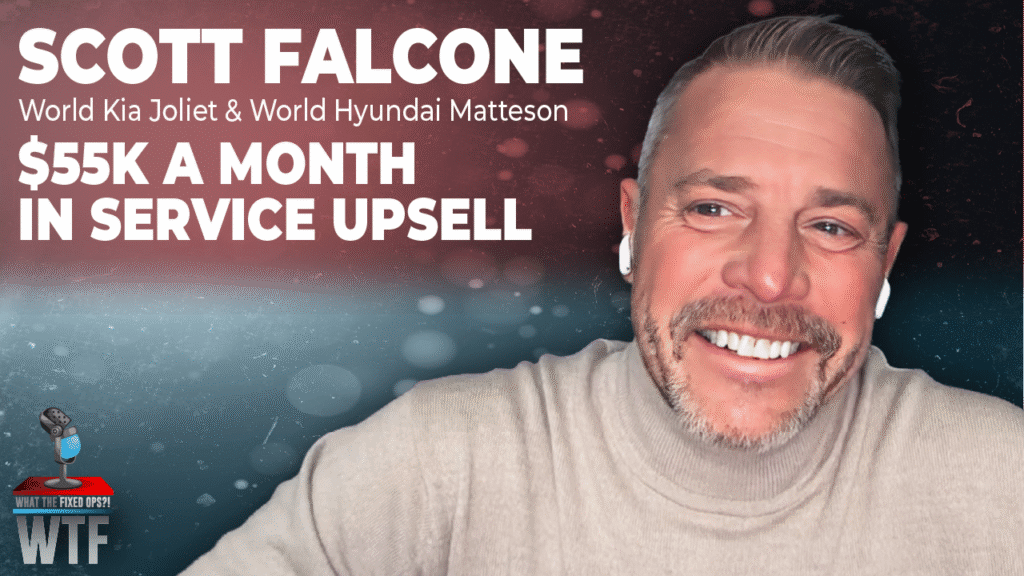
Dealer Scott Falcone joins the conversation to break down the methodology behind his recent fixed ops success. He shares his journey through automotive retail—from early lessons in sales and failure to taking calculated risks, betting on himself, and building a business with intention. His perspective on culture, fear, and accountability is honest, practical, and deeply relevant for anyone navigating leadership in today’s automotive landscape.
Russell and Charity get a true dealer’s-eye view of what productive leadership looks like, covering everything from structure versus calendar flexibility to driving efficiencies in fixed operations. If you want to learn, grow, and hear what it’s really like to run a dealership with intention, don’t miss this episode of What the Fixed Ops?!
Read the Transcipt
Russell B. Hill (00:24.671)
I’m your host Russell Hill of the WTF podcast and that’s what the fixed ops podcast all of you great people out there and I’m joined today by
Hello everyone, I’m Charity, the co-host here today, and we have Scott Falcone with us. He is the dealer at World Kia, Jolette, and World Hyundai Matheson. So Scott, welcome. Thank you for joining us. We appreciate it.
Thanks for having me. Appreciate being here.
sure that a lot of people know who you are and and they know about you but we want to hear from you just a quick overview of who you are and what you do.
It’s pretty simple. Like I said, I’m the dealer at the stores. And I think I probably do a lot of non-traditional things that dealers normally would do that I steer clear of. I came up through the ranks. I started as a salesman in the business. I guess it’ll be knocking on 30 years ago. I had a couple of lucky breaks, promotions that happened fast and early and had a real lucky opportunity to buy into a store 20 plus years ago, 25 years ago.
Scott Falcone (01:38.23)
and slowly worked my way in with small percentages and gambling your life savings over and over and over and things have worked out. So here I am now.
You got two amazing brands, and Hyundai. I mean, they’re, they’re, they’re really hot.
Yeah, it’s it’s it’s no, I don’t think we could have predicted you know this, you know, the the Hyundai store has been there for almost 20 and bought the Kia store about 10 years ago. Had a couple Chevy stores in between there to one you know, I was on the wrong end of a letter in 09 when when General Motors was handing out, know, 1000 letters to dealers. I remember. Congratulations, you’re out of business. And then bought and sold another one along the way. Got a used car store as well. And have also
been in software development for dealers and kind of currently heading in that direction an awful lot right now. You know, we’ve got some things coming out in the first quarter with that, but our brands are really unbelievable. We’re super excited and fortunate to have those.
Yeah, they’re hot. They’re hot brands.
Scott Falcone (02:41.122)
They are. Yep. Different ways. You know, I think that Kia kind of has the hot hand on product right now. A lot of people are, you know, have opinions on the OEM side, you know, who’s doing what for, you know, for whom and so on and so forth programs. But we’ve got a really good relationship, you know, with both manufacturers. you know, it’s pretty hard to complain about, you know, what we’ve got going right now. We’re blessed.
It sounds like, you know, and I’m always curious to ask dealers this, you know, you have an appetite for risk, but you did mention luck. What do you think is the combination that kind of got you to where you are? Is it luck? Is it your risk appetite? Is it hard work? Is it a combination of those things?
That’s for sure a combination and you you’ve got to put yourself out there. You’ve got to take, you know, other risks. It’s not just pushing your chips in, you know, it’s it’s risking, you know, it’s risking failing in all senses of the word. I think that I got into sales probably when I was really young just to overcome fear of not really sure what the fear of was because now I feel like I’m fearless, but I wasn’t. I think that was a learned trait.
And so going to sales knowing you’re gonna hear a ton of nose over and over and over gives you thick skin and it gives you perspective and it also I guess perspective right, you who cares, you know who what do I worry about what somebody thinks you’re gonna be criticized for doing something you’re gonna be criticized for doing nothing might as well be criticized for doing something that makes sense to you and is hopefully good and positive in the world so
I can’t worry about that. can’t worry about failing. you get thick skin after failing enough and you realize it’s just part of growing. There’s certainly no growth going to occur in comfort. So it’s best to get uncomfortable as fast as you can, as young as you can, and realize what a gift that can be when you start recognizing that. So yeah, I think that the luck part is kind of a byproduct maybe of,
Scott Falcone (04:44.75)
opportunity meets preparation and so on and so forth, all the old cliches. And there’s a lot of truth to that. To me, it’s similar to rubbing two sticks together, you might get a spark, that’s the byproduct. So working hard, putting yourself out there, being in the right place at the right time, those are the two sticks that rub together and the spark is luck in some cases. So yeah, I feel like I’ve had a lot of luck and kind of set the table for it. But sometimes it shows up, sometimes it doesn’t.
You just, you just defined in a nutshell what luck is. mean, as far as coincidence or chance personally, I don’t believe in it. You create your own luck and you did that by, I started the same thing. This is my 41st year, but for 16 of those, I mean, started selling 1985. similar to what you, I learned that really my life is at the edge of my comfort zone. It’s not in my comfort zone. That’s where I meet people like you, people that inspire and motivate me to step out because you know, there’s
fear of what you know and fear of what you don’t know. But a lot of people can’t handle that rejection. No, no, no. And no, to me, it’s just next opportunity gets you closer to the yes. All the things you and I and Sherri and that we’ve learned over the years, you win, you lose, but you get back up and you continue to grind. And I can hear some people right now, Scott’s just lucky. He just fell into the right thing at the right time. Well, they don’t understand the 20 years of preparation before that, you know?
I’m a 30 year overnight success, absolutely.
Right. and everybody wants to know how to do it. Why don’t you think about what you’re reading and who you’re associate with and what you’re listening to. It’s working your ass off is what it is. And wanting more and understanding how to cope with no or insecurities.
Charity Dunning (06:30.51)
And I’m curious what you think. Do you think your trajectory would have been different if you had started out, as a porter or, you know, maybe as a technician? Do you think you would have went on the same path or do you think being in sales was sort of imperative to your outcome?
You know, I’ve quite honestly, I’ve only known sales. So I don’t ever see myself signing up, you know, when I recognize that I was able to be in sales, let’s not say I was good at sales until some point. But I guess, you know, when you’re when you’re younger, and you don’t have a lot of options or opportunities, and you know, we didn’t grow up in a, you know, in a wealthy environment, you know, quite the opposite single mom raising a couple kids and so on. And
I figured out we probably were described as broke at a pretty young age and I thought that maybe it’d be good to get to work. And so when you’re young, there’s not too many jobs you do. So you’re a janitor, I’m a baseball umpire, a hockey referee, mean, whatever it took at the time. And as I got a little bit older, I definitely had an entrepreneurial streak or seizure, one of the two, I’m not sure what it was. I think the first thing that I figured out how to
or when I thought sales made some sense was I saved some money up and I bought a gross 12 dozen keychains to take to school to sell in sixth grade. And they were not proud of this, they were, didn’t matter I guess, but they were beer bottle opener keychains because every sixth grader needs a keychain with them. Makes perfect sense, right? And I sold them all real fast and made some money.
went back to this wholesale place in the city where I live in Chicago and I forget what I bought next and took that. so I said, you know, I think if I can steer clear of, you know, the Porter path or the physical labor path, you know, that’s not probably going to generate a lot of opportunity in life. And I did have some random mentors around when I think back to some people no longer in my life and they weren’t there very long. But some of the things that they used to say was, you know, was impactful. know, this is
Scott Falcone (08:46.99)
you know, when you’re a little kid and this is going back a long time ago, right? know, 45 years ago, 50 years ago for me. And they’d tell you how do you how you’d make $50,000. Now that would be the equivalent of, know, how do you make $250,000? Probably $300,000. But one of them was sales. You know, there was inheritance and open your own business and all those things when you’re little kid. That’s just not going to happen. And so the only thing on the list was sales for me. And so, you know, that was kind of what what what grabbed me and drove me there and kept me there, quite honestly.
I was, but that fear was certainly there too. It wasn’t just like, I couldn’t wait to go out and hear no, but I thought that that would be a good path to, for whatever it is you’re gonna wind up doing. Thickening up, I guess is why I got into it, to toughen up. And then it just became my life.
It served you well, Scott. And a little bit about what you were talking about the way you grew up. I think sales in automotive and what it’s done for me has been a real equalizer because I’ve had a lot of things in my life where traditional jobs for, you know, there’s some drug and alcohol problems back in the day. And it’s like those, those really made a lot of things unavailable to me and sales.
in the automotive business was like, it was like the greatest equalizer of all, particularly if you’re hungry and you want it and you’re, and you’re honest and open and willing to learn. at first I didn’t surround myself with people like that. Unfortunately, I didn’t really know how important this hard drive is and what you read and what you listen to and what you hear can really corrupt that hard drive. you know, like you are who you associate with, you are what you eat, all those types of things.
You mentioned some early mentors. Is there one that you could maybe haven’t thought of in a while that might have come to mind?
Scott Falcone (10:38.83)
I probably overuse the word mentor. People who gave me some random advice that stuck with me. I didn’t really have any mentors as a kid or a young adult. think that’s why growing up in scarcity as opposed to abundance also made me very conservative. So I sound like I had a lot of risk and I probably did for most people, but I should have been a lot riskier in the business. I’m sure I’d have a lot more.
But I didn’t. I learned by through failing and pain, quite honestly, you you stuck your hand in the fire and you found out it was hot. And most people will do it three and four times. And that’s the one thing that I, you know, if I had any skill set, was I knew after the first time it was hot. I didn’t have to go back. then, you know, I thought, well, you know, my job ought to be to share this with everybody else, you know.
and be a mentor or a teacher. And I should because it’s going to improve my business anyway. So it’s like, is what you don’t do. I’ve tried this. you’ll make a lot more money. We’ll all make a lot more money doing it the right way. So we would work our way through failure consistently. it’s really something that I encourage everybody to do. I still love to fall down on my face publicly. And I encourage them to do it and do things that are completely outside of their comfort zone.
so that they are uncomfortable. And then when you find something that works, you know, we call it law. And we install it in a process, in a procedure, and it’s law. And we stick with it. When we find out it doesn’t work, we just don’t go back and repeating it. know, Edison, you know, once he flipped the switch and the light went on, he didn’t say, let’s keep working on this thing. He said, I landed the jet, we’re here. Right. Not everybody.
listens to that, is amazing. And I’ve got all the scars to prove it, you know, and all the arrows in my back as a pioneer. And yet they still sometimes want to go down this path that I tell them, don’t go down there. You’re going to you’re going to get the same thing that I got. But I have shortened some people’s learning curves through failing. So I’m the chief, you know, fail officer in some instances in the the company. And there’s a lot of people that like that. And there’s a lot of people that have also
Scott Falcone (12:57.026)
you know, embraced it. Because if they see that I’m okay, you know, falling down or encouraging them or clapping for their failures, you know, they’re more likely to continue to try things.
Absolutely. I have a lot of acronym, one them is for fail. And that’s the first attempt in learning. I had many mentors, but I didn’t have until much later in my life. was the kid that when I got burned, I would see if my left hand would burn like my right hand and I would go at it again. Unfortunately, I made a lot of those. But you know what, I kept getting back up. And then I met somebody I would say like you, Scott, that understood how
getting out your comfort zone and taking risk and just get back up because anything short of fail is quitting. But if you get back up and you keep going, it’s like, I would say I mentor a lot of people probably like you do. Most of them don’t get it. They’ll say the right things, but they stop short of it’s the long game. It’s getting up every day and being consistent and finding out what works. Your thoughts on that?
Yeah, you know, that’s an individual approach or attitude, right? I mean, you know, can, you know, dump all these words of wisdom on everybody. Some people are going to grab it. mean, you know, the saying you can take a horse, a little horse to water, but can’t make a drink. As a leader, the real trick is finding out what makes the horse thirsty, right? And, you know, that is the tricky part.
you if you’re going to spend time you know working with young people or you know people in a company or company you really do have to consider you know what what makes them thirsty and everybody’s a little bit different. It’s a job you know if you’re going to really take those people on quite honestly.
Russell B. Hill (14:44.302)
Absolutely. The what and how can actually come pretty easy if you focus on the why. Is that what I hear you saying? Like what drives it? What is their why?
Yeah, that’s for sure. And discovering it one by one, you know, in a large company, you know, whether you’ve got 50 or 500 employees isn’t so easy. You hope in that case that your cultural approach infiltrates and infects in a positive way, you know, the other executive management staff and, know, fish things from the head down and just the opposite too, right? You know, we can make a lot of impact from the top down with just a handful of people. So you hope that the culture kicks in and that
instance what you’re saying and that your team is going to continue to know spread the gospel so to speak.
ask you about your culture, Scott. What kind of culture do you like to promote? And in addition to that, I would love to hear what differences you have found between age groups in your business. Do you find that there’s a huge motivation difference between the older working groups and then the younger ones?
I’ll add, I’ll answer your culture question. initially, I think, you know, you know, you, you know, lot of definitions of it. mean, I think that, what you do when nobody’s watching, you know, is one definition of your culture. And you know, you only, you know, that, but when, people realize, you know, what you stand for, what your brand represents, and so on and so forth, you know, that’s what.
Scott Falcone (16:21.72)
what culture is inside of a store. But it is, once you know what you’re supposed to do and have a standard, you have to adhere to it. You have to stay the course, right? We run our business on process and procedure, not gut hunch, not instinct, through all of those failures that led to law. Why would I do anything different than that, right? So when you talk about a culture, you know, we have very high standards, a very high bar for
a variety of things. Some of them might seem insignificant. Our scripts are very important to us, not that you say the exact words the exact way, but so that you understand the concept of it and do things in your own way, but little things that do make a difference that add up. that’s the type of culture that we have. It revolves a lot around solid standards and processes and procedures. As far as the differences in
you know, the age gap and the differences in workers. I think that it’s, I don’t know that there’s that much of it. Certainly there’s a difference, but you know, you’ve got great players, right, you know, that are 23 years old, then you’ve got lazy 23 year olds, and you’ve got great 55 year old, you know, employees, and you’ve got real lazy 55 year old employees. you know, nothing changes in that regard, right? And you manage them.
and you lead them accordingly. And accountability, I guess, if I left that out of our culture, probably sits at the top of the pyramid, quite honestly. And I think with process and procedure, it’s almost a given. But we are a very accountable company. we don’t give a ton of chances, quite honestly. We don’t just…
consider somebody’s career over for a mistake. But if you’re a repetitive offender, you’re just not fitting into our little community, right? And nobody wants that, not me and not the producers, right? Because eagles don’t fly with turkeys, period. You’ll never see those two animals together. You’ll never see eagles packing around for scraps. And you’ll never see turkeys soaring with eagles, right? So you can’t keep turkeys in your organization.
Scott Falcone (18:42.22)
Right? And count on the Eagles to support them. Because the Eagles will leave. Right? And you’re going to lose your best people by allowing your worst people to not uphold your standards. So accountability is also a big thing. And so holding everybody accountable, whether it’s the youth, you know, or the seniority, you know, it has to be doled out fairly. I don’t believe in equal. I believe in fair in a manner in which you’ve earned and deserve to be treated. Not the same.
but you still gotta dole it out, that’s for sure.
That’s a good one. Yeah.
I love that. We’ve heard similar, fair but not equal treatment before. And it seems like a great way to manage and a great way to keep.
All of your employees are on the same level and all of them happy. Let me tell you about a partner that’s actually helping dealers get ahead, Global Dealer Solutions. If you’ve been wondering how to use AI the right way in your dealership, especially on the fixed side, these are the people to call. Their team gets it. Not just the tech, but the real challenges that dealerships face every day. We’re talking about conversational AI that doesn’t just respond, it converts. It books appointments.
Charity Dunning (19:58.736)
It’s not replacing your team. It’s making sure your team can focus on what matters most, closing ROs and building relationships. But GDS isn’t just about AI. They train your staff, drive traffic, and tighten up processes so your results stick long after the tool is turned on. And everything they do is built around one goal, growth that is real. If you want more
service traffic, better follow up, and a partner that’s always a step ahead, check them out. Visit gdsdealers.com, follow them on LinkedIn at gdsdealers, or just shoot them a message and ask, what would you do with my store? And see what they come back with. Global dealer solutions, process driven, people first, always on it.
When you made a particular decision at your store based upon what you just said, that maybe looked small at the time, but it ended up having a huge impact. It would probably fit into some of those cultural things that you just talked about. Is there one that really surprised you?
There was one that I remember as a young, early GM at a store that I was fortunate enough to be involved in where we were, you know, we went from 80 cars to 500 cars. And at the time we were knocking, you know, on the, in in the fours and we had a team of about 40 salespeople and just a, just really a zoo and a crazy place and a lot of fun at the time. And we had a salesperson there who was a veteran and
He wound up he wound up in the store and he was a guy that was putting out, you know between 25 and 30 cars Good gross solid, you know, but what he was just cancer and he was just tough. He was late He had he had substance problems and all that, you know and I worked with him and managed him and everything else and he He just didn’t want to cooperate on any level and I remember he he kind of gave me well He gave me you know, it was an either-or right and ultimatum
Scott Falcone (22:05.376)
And I remember my office, there was no door on it. There was walls, but there was no ceiling. It was kind of strange. And there was a door, there was no doors. I don’t know why we had the walls. And you could see through everything going that way. He had come in and I probably would always have six or seven people in there waiting for deals and whatever. And he laid down some ultimatum. I don’t remember what it was. And I sat there for a second while everybody looked at me. that was the first time anybody had ever done that. And I said, this will be my defining moment.
And I said, I’m going to let you know something. I honor all ultimatums. So, you know, essentially I offered him the opportunity to leave and I said, now, if you want go back to your desk and rethink and rephrase what you just said that you would appreciate it if I would do this or I would consider that as opposed to do this or else. said, I’ll give you a second chance to rephrase that if you want to. And he chose not to. then I chose to, you you victim from the building and.
That was a defining moment for me that I said that I will always honor all ultimatums. will give you a chance to rephrase it because some people don’t realize what’s going to happen, you know, because if you don’t stand for something, you’ll fall for anything. that one’s always served me well. No ultimatums in my life. I’m not going to be a hostage. we do have some people that are leaders in the company that are still hostages. They’re hostages in the service department to a bad advisor.
right, or a bad technician or something. Well, I can’t replace him or this and that. You know, you can’t go through life as a hostage.
No, it actually costs you more in the long run. It just causes a dissension in the ranks because like you mentioned, you have a culture and you stand for certain things and being fair, but accountable as well. People, most people wouldn’t 25, 30 car a month guy. They’ll keep them on given the poison and the cancer, but it, it, it hampers your growth.
Scott Falcone (24:03.126)
Yeah, you hear so many stories about the opposite side of that. And so many people are so happy when they finally make the decision. you do that a couple times. And guess what happens? Now all of sudden, that becomes part of your culture where the Eagles see that. they don’t fool around with this. know what mean? The guy’s a producer, she’s a producer, but they’re not going to allow cancer to infiltrate this place. And it’s better. those are things you got to do quicker than most people are willing to do them.
You know, people make changes with pain and pleasure and pain motivates about 20 to 1 outside of that. But the faster you pull the pain forward of getting rid of this 25 car cancer or this advisor who can’t show up on time 15 minutes late every day with a line outside and so on and so forth, but they’re producers. The faster you suck the pain up of keeping those people on board and get rid of them.
The faster you move on and that’s that sends a message to your people as well that you do stand for something and accountability matters
Yeah, I had, I all of us probably have some experience that we’ve ever ran a store to any level and they think they’re, they can’t be replaced and I would never get fired. And, somebody, maybe that was a wake up call for that guy, Scott. Maybe it was, maybe it was.
I’m sure that the people that we’ve we’ve let go and terminated, you know, there’s there’s there’s so many managers in in the in the in Chicago market, you know, of people that have worked with us in the past and who were sales or in management that just, you know, they they just didn’t make it. And and they went on to great careers and successful careers. And I feel really good when every now and then somebody reaches out, you know, 10 or 15 years later after.
Scott Falcone (25:52.718)
I threw them out and they thanked me or they appreciated it. I wish I was smarter and had figured out a way to work with more of them because I’d have the bigger and stronger staff. But that’s okay, they went on to do good things in the industry and I’m happy to have been part of their successes too, even through some temporary failures.
An old boss of mine, uh, he actually was, uh, I worked for Vantale for many years and he was, uh, had 30, 30 Vantale stores as a, as a managing partner before they got bought out by Berkshire Hathaway. Anyway, in 1994, he fired me. And, uh, uh, he’s fixing to visit with Cherry and I, cause he’s had a tremendous impact on my life. And so we’re going to talk about that. And, uh, we talked a little.
every year I communicate with him in this one particular way, but we had a 30 minute conversation. it yesterday? Maybe the day before yesterday, to get it further thought. we kind of opened up some things that were happening back then. And he had no clue that he had that level of impact on my life. and it did, it was a, it was a defining moment. was, it was, it was that fork in the road and it was either hell fire and damnation or, know, or, or get it together. And it.
completely changed my life. People like you need to hear that when you fire people. Sometimes they get it, other times they don’t. You just love where they’re at and move on down the road,
Yeah, sticking back to somebody who I respected, still respect a lot and I had a conversation this is probably years ago, 30 or so and it just his philosophy on firing and bringing people back and he said, depends on why I fire them, you know, sometimes eagles need a chance to spread their wings and I said, that’s a good philosophy. I’ll take the high road and I’ll remember that. So, you know, we normally will
Scott Falcone (27:52.896)
reconsider rehires and challenging times in people’s lives too, right? You people, you you said yourself, you you struggled with some issues and you you were a different guy from who you are along the way to now. And I certainly believe that in the industry and the industry is, you know, talk about a double edged sword. mean, it’s such an amazing industry that allows for so many wonderful second chances for people, you know, just unbelievable.
I absolutely, you know, I love and embrace the industry for forgiving, you know, those without education and just those that lack an opportunity to succeed on so many levels. And I hate the industry because it allows for that as well. You know, we don’t have, there’s not a lot of tests to get into this business as you know, that you have to pass, but you know,
I’ll take the, I’ll take that glass half full side of that as the other side of it. You know, when you think how did this person get into business and you go, well, the same question could be asked of, you know, your guy over there that’s exactly that’s delivering 30 cars. And, know, I had to go through some of them to get, you know, some of her or some of him, you know, you just got to, you just got to.
Sometimes it’s not even second chance, it’s third and fourth.
chances.
Charity Dunning (29:12.546)
Yeah. Yeah. I wanted to ask you, Scott, what is the number one struggle that you have as a dealer? And it happens no matter what is no matter how good things are going. You still always have that struggle.
We should, you know, we are struggling with scaling because we’ve not taken recruiting seriously enough. We really haven’t. And, you know, I do have a full-time recruiter that I may or may not need for, you know, our operation, a couple of hundred people. But I’m really glad that we have one and it’s, you know, in the scheme of our expenses, it’s not that terrible. And it’s…
This particular girl that’s working there, she’s what I like about what she’s doing that’s helping us right now. And it’s important right now because I know we have the ability to scale to do so much more with what we’ve got. You know, we’re our facilities are all done. You know, we were well capitalized. You know, we have inventory. There’s just no excuses. We market. We do it all right. So why aren’t we doing better? And we’re doing really well by all standards. And but we have a high bar. So she
really has helped with pointing out to our executive team, who is normally in the hiring process, right? You know, somebody at the GSM or new car manager level or general manager is going to be involved in hiring for the BDC for sales and so on and so forth. And they do a pretty good job of that. They select some pretty good people. They go through the right processes. You know, they check the boxes, they do things. And then they get there and they’re gone. There’s just, you know, the
The integration into the store, it just ends. And there’s the management staff and there’s the sales staff and they’re not even doing it on purpose. Like, well, we hired them, who cares, figure it out. They just get caught up in their busy life. know, their sales driven life and they lose sight of their administrative life. And you know, I read something somebody was talking about and they used this phrase to…
Scott Falcone (31:24.014)
front and back of a sentence or something and it was about admin and away and it was, I pieced it together, you can’t admin away your sales team, your sales, your producers and I call it clerk work. I don’t want more clerk work on my producers. Number one, it makes no sense to do that right when they’re there to produce. But number two, they’re probably not cut out for it.
The reason they’re a producer isn’t because they’re organized, right? Or they’re really good at Excel or any number of other things that you wish that they were and they’re not. And so, you know, we have to continue to give them support. Well, that’s the same thing that’s happening with my big struggle, which is recruiting more people and better people in volume. Really, we need people. I certainly want great people, but we need more people just to handle the leads and to handle our customers. And she’s, you know,
been working a lot harder in that one week to two month period to get them on boarded properly and to integrate them. And that has been my biggest struggle right now is really to make sure that, you know, the overall culture is, is, hey, we’re excited about your career here and you know, they’ll work so hard and put money in their pocket. You know, the salesman and the BDC, you know, the management staff will, they’re just the best in the business at what they do, you know, making deals that should never happen.
and so on and so forth and the salesman really loved that but salespeople need you know more than just a check in some cases you know and they’re not going to get to a check unless they feel integrated you know in the system either right you know be like I didn’t get this nobody’s paying attention to me and you know and you know I love when it well whose job is it you know to to do whatever the case may be and you look at one of your you know your leaders and it’s every it’s everybody’s job I said so essentially it’s nobody’s job
Right? Because when it’s everybody’s job, it’s nobody’s job. It’s, know, if you don’t own it and take complete and total ownership of a task, there’s a high likelihood it’s not going to get done. So that, you know, is something that we work all the time on maintaining because even though they all know that, they all gravitate away from an administrative clerk work environment back to, you know, the producers that they are. I mean, if you’re a thoroughbred, there’s one thing you want to do.
Scott Falcone (33:49.91)
run. That’s it. And, you know, we have quite a few thoroughbreds and, you know, they are the ones that generate the dollars that allow us to pay the bills in every other spot in the store. Right. And so those thoroughbred need to be treated as such, not prima donnas, just thoroughbreds. And we have to continue how, you know, with with good expense control to to support them with, you know, the admins and the clerks of the world. And it’s not just a luxury.
you know, maybe, you know, 10 years ago, we’d be talking 15 years ago about that to be a luxury. Like, wow, you got a lot of clerks here. You know, when I look at my 20 group composites and things, and I look under admin, I got a lot of, I got a lot of expenses there, but you know, we got a lot of gross and we’ve got a lot of other things that offset that. And you know, you know, when I look at the bottom line, somehow we figured it out. And now, you know, with OEMs and with just compliance, you know, state or federal or any number of things, you know,
Adding clerks, if you will, admin slots is critical, but you may as well not just do that to push paper around a desk, you may as well do it to support your producers. And so we’re trying to hire these hybrid people that, know, 50 % of your job is going to be make sure, you know, we hit brand ambassador, you know, to the tune of whatever. So nothing falls through the cracks because, know,
a program like that or something, you know, for another OEM that has hundreds of thousands of dollars annually or millions on the table. And, you know, your two month, you know, employed lube tech missed a certification and just cost you 50 grand or 100 grand and the service manager is too busy. You know, so, you know, we’re to hire for a position to make sure that we don’t miss out on four or five hundred thousand dollars. And it’s going to be a, you know, a six times, you know, return on investment. But we’re to give that person something else to do, too.
They’re going to support three managers maybe with areas that they’re struggling in. So I hope that was an answer to your question, Charity. I know it took a while to land the jet, but that’s my…
Russell B. Hill (36:01.004)
You landed at, well, if you have thoroughbreds, they need to spend 80 % of their time running. That’s what they need. If they get bogged down in the other stuff, just, just combobulates them. Took me a long time to figure. I only do a few things really well, but I spent a lot of time in my life trying to do the other things that I thought I should do well, but are not part of my makeup and what I do. having that, that, that administrate that, that’s, that was a pretty valuable stuff. Thanks for sharing that.
Yeah.
Yeah, well, how about tell us something about your stores that would break in 30 days if you weren’t paying attention?
Russell B. Hill (36:41.528)
Be careful, Scott.
Yeah, I know I got to tell you, I don’t think much would break. I don’t think much would break. Another philosophy I adapted a long, long, time ago was I’ve never been afraid. You’re growing through the industry from sales and to a finance job and a director and a general manager and so on and so forth. You did it because you were producing and productive. You did something right and you were
you were measured, you know, there was a scoreboard and you were, you did well on the scoreboard and promotion came in. And I remember just watching a lot of people that, know, where they would keep the death grip on the steering wheel, you know, because they had a job and my job was this and they didn’t want anybody else to know how to do it, right. For fear of, I, and I, and that is how you don’t scale. That’s how you stay. Exactly. You know, and so, so my philosophy was just the opposite. So I would invite.
everybody into my office to sit in the office and here’s how we’re going to call in a deal. Here’s how we review credit bureaus and here’s how we do apps and there would be salesmen. We would have class all day long and anything that I could learn and it was I wasn’t afraid of being pushed out. I figured I’d be pushed up and that’s pretty much what had happened. So I’ve stayed that course forever and our people are you know.
whatever I have in knowledge is anybody can have it. Most people you can hand them a manual and the keys and they still won’t do it. So I’m not really afraid of sharing knowledge with anybody because they’re just this won’t do it anyway. You know, and so that you don’t even make them a competitor. You know, you could give them the keys to the kingdom. But so the knowledge, the culture, the accountability, all that stuff, I think our team has it, you know, all the time. Nobody’s perfect. They’re not certainly me either. But I don’t think much would break if I don’t show up.
Scott Falcone (38:34.026)
And I don’t show up more and more often, kind of on purpose. That doesn’t mean I’m not working or not around. I work from different places or I’m available to them. And I’ve just decided to take on some different projects for the stores. A lot more vision for those guys. we would be in good shape. If I don’t show up or drop dead, they’re going to be OK.
That’s powerful. You’d be surprised. More people would answer that in a different way. And that has a lot to do. And I actually suspected you would answer it that way based upon the things we’ve already talked about because of your level of conviction and confidence and who you are and what you do and understanding. You couldn’t have got where you’re at trying to do it all yourself. And you don’t want to share it with anybody else. It’s what makes you successful is exactly the opposite. Thank you for sharing that nugget.
Yeah, probably if we were talking to someone that’s not doing so great, they would have said everything. Everything would break. If I wasn’t there, it would all be a dumpster fire.
Yeah, then you’ve been leading in the wrong fashion, if that’s the case. That’s not supposed to be how it’s supposed to be, as we know, right?
This is our fifth year doing podcasts. A lot of people start them and they don’t finish them or don’t ever get started.
Scott Falcone (39:50.488)
Congratulations, that is a long time.
Thank you. It’s all because of her. But if someone showed and actually, I don’t, we’ve never had a guest that would actually say the opposite. But if they did, a lot of that would be edited out because we don’t want our name associated with that. said, it’s not my fault. It’s his fault. How in the hell did you get here? You know?
Yeah. Yeah.
How about this one Scott, when you walk into your stores on any random day, what three numbers do you care about most?
You know, just out of habit, you know, being a salesman, you know, I kind of roll my eyes right around the corner and depending where I have to get to the sales board, you know, what’s going on and then make sure that there’s no fires, you know, burning. that’s probably the first number. I, I don’t, I don’t lead well, manage well with, with a ton of structure. I’ve tried. I thought that structure would help me.
Scott Falcone (40:54.7)
a lot, you know, and, and a better calendar and so on and so forth. And now I find white space in my calendar, you know, is actually productive. And I also think that I do a better job and more productive and can contribute more in so many ways with people, the team, whatever, on the fly.
It doesn’t work for a lot of people. You know, they would call that unorganized, but I like to keep a calendar open so that when something shows up, not a fire, you know, an opportunity I’m available for it. I don’t want to say no, because I’ve committed to, so I don’t make a ton of calendar commitments. now that doesn’t mean I don’t have a plan and I sit around waiting for something to show up at my doorstep. That’s, that’s a, that’s a bad plan, right? And I do love like,
probably most people, you know, living with a checklist. Who doesn’t like, you know, checking something off, scratching that thing off, you know, gives you such a good feeling. But, you know, if it doesn’t represent something productive, you know, that’s not too exciting. And I think, you know, there’s people that have dysmorphia, body dysmorphia, right? They just, think that no matter how beautiful and wonderful, there’s just something wrong with them. I feel like I might have productivity dysmorphia. No matter what I get done, you know, I just log, you know,
10 amazing hours, you know, working on some software that’s just going to help us. And I’m like, I couldn’t do 11.
Well, that’s one of the, you know, successful people do daily, average people do occasionally, Scott. So that’s what makes you successful. I love the fact that you keep things open because you can be counterproductive. There’s a lot of grind to this because I consider myself an entrepreneur starting this company one month before me and my business partner, one month before COVID hit. And we’ve been extremely successful, but that’s from a lot of mistakes and that we worked through that made us better.
Russell B. Hill (43:01.582)
One of them was having a, we have 41, 42, phenomenal onboarding process. Okay. People know where they stand, what they’re supposed to be doing. And when we’re all virtual, one of the things we pride ourselves on that people count, they matter, they make a difference. And we let them know it, not to the point where they have to have it to perform, but you know, we were very empathetic towards people and allow them flexible schedules as long as they get their work done, but they know where they stand at any moment.
But then you have people that just don’t, it’s not enough. know, they probably work too much.
Yeah, and you know, the productivity thing you’re talking about, you’re moving from this to that, if that makes an individual more productive, that’s great. And there’s, you know, people who get it done and people who don’t watch a clock, people who do, and so on. you know, we, I don’t allow remote. That’s one thing that I just don’t allow. You need to be in the store and be part of our culture to see it and feel it and everything else. Sure. I just don’t have a job.
you know, on the books that allows for it. Not to say that if I really did find something that made sense that you didn’t need to be in the store, wasn’t cultural, wasn’t, you know, witnessing what’s happening, you know, I would consider it. But right now, you know, you might be able to stay home and work for a day because you’re on something or here or there, but by and large you’re in the store.
Yep. I like that for, for many, many, many, many years when I was selling, I met, had a, a methodology and three days a week minimum, I would come in early and work the service drive. Okay. And then as I worked my way up through the ranks last few years as a GM and a, a Nissan and Mitsubishi store, it’s like, I always got along. I always talked to people and had relationships with advisors and technicians, et cetera, but I was not really a fixed guy. So.
Russell B. Hill (44:51.81)
What about fixed operations for you? I surrounded myself with people that knew intimately about that and it would advise me. And we haven’t talked much about that, but you did mention advisors and technicians. What, what, how’s fixed operations going?
for you. It’s the last couple of years, we are up at both stores probably. One store were up 100 % in numbers. And the other stores probably up 75 to 80%. Both stores have almost doubled in the last three years.
The one that’s a hundred is Kia.
Well, you’re right, actually. But it’s because of it was mostly because of a production facility issue. You know, our building was just too small, not enough base. So I purchased some property down the street, you know, three and a half acres, and it’s a 17,000 square foot building. And we put a used car store there because we also needed storage, you know, to keep three, 400 new cars in stock. But it also had five service base down there. So we moved all of our UCI’s down there. I moved all of my PDIs down there. We put two techs in there and some other things and that freed up.
time for advisors to sell and and you know, we’ll call it our main shop and get people in there and slow down and and get them to sell. We also have you know, it’s kind of a hybrid quick lane. We don’t have quick lane or identified as that, but we do have advisors and we assign cars to the the quick lane advisors based on miles. Got it. And so anybody you know, we’ve worked our way down. We started at 50 to see what it was and 40 as we
Scott Falcone (46:33.038)
developed this thing, I think we’re down to anybody under 25,000 miles goes to, and it may be less than that, it goes to the quick lane. We do know there’s limited opportunity, there’s something there, right? You know, we’ve got 15 Ks, and we’ve got, you know, filters, and we’ve got a variety of things and flushes and so on. we give that to those people. And then anything above that goes into the main shop, main they’re written up by a different set of advisors who slow down and have time to present, you know, so that has been
Amazing and when we cleared out the shop we on we un-congested it too You know like UCI’s can clog up a shop for sure PDI’s PDI’s you know don’t have to be in a bay They can be out in a parking lot with tablet now, but it’s still it’s it’s car here It’s and we don’t when you don’t have space everywhere clogging things up So it’s opened up a ton and at the Hyundai story went through a you know about a ten million dollar remodel Which you know normally would be a ground-up job, but in our case it was a remodel
And we expanded our service department in the bays and that has helped. We did the same thing with regard to the quick lane and other advisors. We work with Dynatron and we’ve been with them for probably about four years. we’ve definitely had a, you know, I’ve always understood ELR and the importance in some of those things. I don’t think that our service managers in the past, you know, have really
done a good job understanding the critical nature of that. I have technicians that don’t know what it means. have advisors, you for them not to understand what that concept is, is pretty mind blowing. They all do now. They all do.
Ron knows there, they know there’s, you know what.
Scott Falcone (48:14.102)
Yeah, so those things have all really, really made a significant impact in the business. And, you know, we are working so hard on maintaining, you know, a super strong ELR so that we can file for, you know, a super strong labor rate increase on warranty that, you know, on the culture side of that, that’s a big part of our culture.
We’ve locked discounts out. Nobody can discount. If you’re going to discount, it’s got to go through a manager by the time you find somebody. Hopefully you’ve written the deal up and whatever. And we’ve also in the service drive added a position that I’ve talked and talked, you know, didn’t act on it for years that we should have a TO manager in the service department. You know, we TO every up that comes in the sales department.
And we’d sometimes, and most of the time we T O them twice. You know, we have a manager whose title is actually T O manager. And, and they see how many people that they see, but we had nobody in the shop. So we’ve, took somebody from the sales department at the Kia store and, um, and put her in the department with no experience. Um, I gave her some, uh, some, it’s an AI repair analysis tool that I built and she’s leveraged that she is understanding how an MPI works. She’s learning her way around there. And in the first,
three full months she has averaged about I think her numbers are averaging now somewhere around $55,000 a month in upsell. T oing declines. These are people that are there. We’re not waiting three weeks to send them an email that says here’s 5%. We’re going to get them right now. And shame on me, right? For knowing that.
my god.
Russell B. Hill (50:01.364)
This idea.
I should have, that one should have pulled the trigger on a long time ago. So once we did that, we then found what we think is the right person at the Hyundai store. And he spent a couple of weeks training with her. It’s a process. He has a little more background in the dealership at a little bit of a higher level. And he’s pacing, this is his first full month, and he’s pacing the low mid forties right now. And I think that he’ll get to 50 all day long.
That’s how much money has been left on the table, you know, in six apps for us all this time. Unbelievable.
You get it. It’s like salespeople maybe talk two, three, whatever it is a day. And advisors is like 10 a day. It’s triple. And it’s like there’s all, and they just don’t have that relationship active. All those things are imperative. Uh, and what you did with the PDI and UC that was, that was phenomenal. Get that out of the way. Uh, man sits, uh, good for you, man. I hope everybody out there heard that one right there from Scott. Okay.
Scott, have so many more questions, but not enough time. So if it’s all right with you, I want to ask you one question about a vendor and then we’ll wrap up. I have a lot of questions about vendors. I’m kind of fascinated at how dealers see vendors in general. In your opinion, what’s a vendor behavior that earns your long-term trust? And then of course the opposite.
Charity Dunning (51:37.142)
What immediately do you see from the vendor and you just say you walk away?
I think you need to know your product before you walk into a store. You know, I remember when a digital paid search team and this is a big company, okay, that had been pitching us and they would send different people in or out or we would meet with somebody that would at least knew what they were doing in a little bit of a higher level. I think we were giving them serious consideration and they sent in, you know, I’m just gonna describe.
who it was, not because I’m beating anything derogatory, but incomes are recent. And I found this out because I had to ask the question, college graduate, young female. And she just immediately impressed me as somebody who didn’t know anything about digital strategy. And I started asking her questions about SEO and a couple little things, and she had no answers whatsoever. then I asked her how long she’d been out of school recently.
excited about your new jobs because I told me about all that. And I said, you’re going to be in trouble. I said, a ton of trouble. said, hopefully this will be a great meeting for you. We’re not going to be able to do business because you don’t know anything about this. It’s just as I really don’t. And I said, you should go back and you should really get in your manager’s grill about this and say, how do you expect me to go out and talk with dealers? Because by most dealers would say, just get out or I’ll take my box of donuts and know.
your nice eye candy sitting here and hang out with you today. And you know, that’s what she would get and never, never learn or never grow. And that was the vendor that I didn’t respect. You know, that was, I remember that story because there’s there’s still quite a few of those. know, I think that, you know, picking anybody out, I just think that those things develop, you you can kind of spot the good ones a little bit at the beginning, how much effort they put in, when are they willing to talk?
Scott Falcone (53:37.864)
You know, do they only work off of a standing meeting, which I hate. Those are the things that I’ve eliminated from my life. You know, it’s a standing meeting. know, a standing quick lunch. are just, time sucks. You know, they’re stealing from me.
Just give me the $500 and don’t worry about all that.
So these vendors that are available when I need them to be available, those are vendor partners. And so they pick up their phone, they answer an email, they’re responsive, they’re engaged, and they’re knowledgeable. They are students of the game, right? It’s their craft, they get it, and they respect what we are doing and trying to do. And those are the people that you like keeping in your professional life.
This that great quick, does it matter if it’s virtual or, they have to be in front of you or are you okay either way, long as the job’s getting done and you can communicate.
Yeah, what’s the nature of my solution journey? If we can solve the problem and wind up with a solution on Zoom, then let’s get it done. Sometimes that’s more impactful, right? Because we’re sharing things. mean, there’s nothing worse than somebody coming out with a laptop and wanting to turn it around. Let’s see if either one of us can see it. You see that chart? I do see
Charity Dunning (54:55.662)
Yeah, not that well.
Like you should have just stayed in your office, you know, and we could have done this. This would have been effective, right? And, you know, as opposed to that meeting, that’s a dumb meeting. And then there’s other times, you know, when we need to walk around, I guess, but we can get a lot done remotely.
Yes, you can. It’s very efficient, much more efficient. Definitely, we value your time too, and we don’t want to keep you too long. And I have a ton of questions, but I’ll skip to the very end and ask you, Scott, is there anything you expected to mention or that we didn’t ask you today that you wish we had?
Right.
Scott Falcone (55:31.79)
No, I was your guest. I’m here to answer your questions.
So we have a lot more too.
Yeah, we appreciate it as well. We know your time is very valuable.
No worries, no worries. I was happy to be here, thank you. It was great talking with you guys and people like you and talking about the business is always exciting for me and I leave the conversation amped up and a little more motivated to go produce.
Yeah, and we learned so much from our guests. We really appreciate talking to all the different perspectives and sharing it with our audience.
Russell B. Hill (56:09.1)
Right. Absolutely. We’re humbled and honored and grateful, Scott, Scott Falcone, dealer principal of DealWorld and World Haunted Madison and Joliet, right? Joliet. Now say that right. Okay. Sometimes I wonder if I say Joliet, right. But listen, we’re humbled and honored once again to have you on. And a lot of you, when this comes out, you’re going to love the nuggets dropped. I encourage you to watch it, to listen, take note, reach out to him.
say hello, whatever. There’s a lot of tidbits there. Most people keep coming back and keep coming back. And we’ve been so successful because of having people like you on that dropped those nuggets right there that that’s what we’re known for instead of just a bunch of nothing there. And you brought a lot of value to our listeners and to Cherry and I as well. We’re grateful. Thank you, Scott.
Thank you. Thank you. I enjoyed my time with you guys. Appreciate it.