
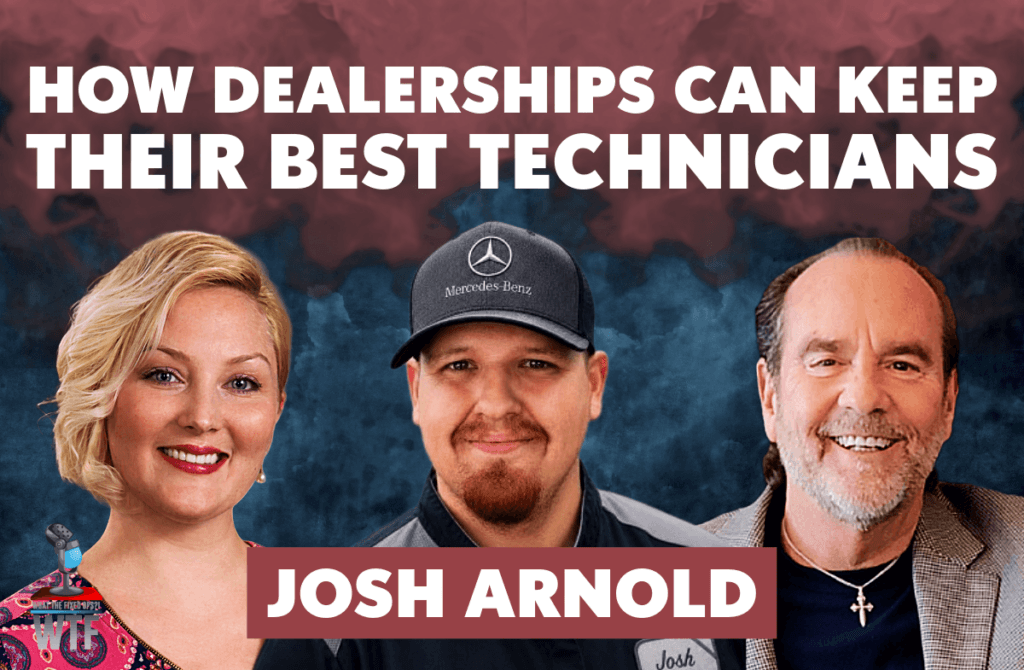
The automotive technician shortage has become one of the biggest challenges facing dealership fixed operations, but the problem may be more complicated than simply not having enough people interested in the trade. Young technicians continue to enter the automotive industry, yet many struggle to find the mentorship, career development, and leadership needed to turn an entry-level position into a long-term career. During his appearance on the What the Fixed Ops?! podcast, Master Technician and Within Spec Co-Founder Josh Arnold explained why dealerships need to rethink how they recruit, train, develop, and retain the next generation of automotive technicians.
Arnold’s own automotive career demonstrates what can happen when young technicians are given a clear path forward. After entering the industry with little automotive experience, he set an ambitious goal of becoming a Master Technician within five years. Strong mentors, clearly defined objectives, and a willingness to push through difficult learning experiences helped him achieve that goal. But reaching Master Technician also revealed another challenge within automotive careers: once technicians reach the top of the traditional career ladder, dealerships often struggle to show them what comes next.
According to Arnold, the automotive industry may not necessarily have a shortage of young people willing to become technicians. Instead, dealerships face a shortage of qualified technicians because many organizations are not properly equipped to develop interested candidates into experienced professionals. The first several years of an automotive technician career can be difficult, and younger employees are constantly comparing themselves to experienced technicians who make complex repairs look easy. Without mentorship and encouragement during those early years, talented employees can quickly become discouraged and leave the industry entirely.
Mentorship is therefore one of the most important tools dealerships have for improving automotive technician retention. Arnold experienced both sides of this dynamic early in his career when a technician who would eventually become one of his mentors initially told him to leave the industry while he still could. That attitude remains common among experienced technicians who have become frustrated with the trade. Arnold believes veteran technicians can be honest about the challenges of an automotive career without discouraging the people who will eventually become the industry’s next generation of Master Technicians.
Creating a defined technician career path is equally important. When Arnold first explored automotive training, Toyota’s T-TEN program stood out because it clearly outlined the steps required to progress through the industry. Dealerships can apply the same principle by showing employees what advancement looks like, what skills and certifications they need to develop, and how their compensation can increase along the way. However, creating a career path on an employee’s first day is not enough. Leaders must consistently check in with technicians, understand their goals, and identify moments when an employee may be experiencing burnout, frustration, or stagnation.
Arnold also believes dealerships should rethink how they recruit automotive technicians. At career fairs, potential technicians frequently meet recruiters or managers rather than the people actually performing the job. Arnold prefers putting technicians in front of future technicians so candidates can hear an honest explanation of what dealership life is really like. That transparency helps young people understand both the challenges and opportunities of automotive service before committing to the career. Recruiting talented technicians is important, but creating realistic expectations from the beginning can be equally valuable for long-term retention.
Customer communication represents another major opportunity for automotive technicians to expand their role within dealership fixed operations. Arnold became passionate about video multi-point inspections after experimenting with technician videos early in his career. He discovered that customers responded strongly to seeing and hearing directly from the technician working on their vehicle. After continuing to develop his approach, Arnold eventually trained approximately 150 technicians on video MPI, emphasizing that the purpose should extend far beyond simply selling additional service.
For Arnold, an effective video MPI is about education, transparency, and customer retention. A technician’s responsibility is to provide customers with accurate information about their vehicles, explain priorities, and allow them to make their own decisions. When customers are working within a budget, technicians can explain which repairs should receive immediate attention and which services can potentially wait. This approach transforms the interaction from a sales pitch into a conversation centered on taking care of the customer, helping dealerships build the trust necessary for stronger long-term service retention.
Improving technician retention also requires dealerships to invest in shop leadership. Arnold believes the shop foreman role has become undervalued at many dealerships despite its importance in technician development. A strong shop foreman can serve as the person technicians approach for technical guidance, career advice, coaching, and support during difficult moments. Service managers already balance customers, advisors, technicians, parts departments, and operational responsibilities, making it difficult for them to understand everything happening inside a large shop. Investing in dedicated technician leadership gives dealerships another layer of support for developing employees and strengthening shop culture.
Ultimately, Arnold believes the automotive industry must become more willing to challenge the phrase, “That’s just how we do it.” Vehicles, customers, technology, and employee expectations continue to evolve, meaning dealerships cannot operate exactly as they did a decade ago and expect the same strategies to remain successful. From technician mentorship and career development to video MPI and shop leadership, continuous improvement must become part of dealership culture. The dealerships that successfully address the automotive technician shortage will be those that do more than recruit employees—they will create environments where technicians can build careers, develop new skills, find meaningful mentorship, and eventually give that knowledge back to the next generation.
Read the Transcript
Hello everybody out there. I’m your host, Russell Hill. W t f and that is what the fixed ops to all of you out there. And I’m joined today by hello everyone. I’m charity co-host here today and we are joined by Josh Arnold. He is the co-founder of Within Spec. Josh, welcome. Thank you very much for having me. Yeah, we are excited to have you tell us a little bit about you and what you do. Yes, I’m a technician. I’ve been a technician now for close to ten years. Uh, most of my time was spent with Subaru and Toyota and most recently going into the Mercedes brand. Uh, more importantly, most of my back half of my career now, um, I became a master technician after about five years, from somebody who knew nothing about how to do an oil change to, you know, obviously mastering out and changing engines, transmissions, whatever the job entailed. But around that five year mark, I really hit a low point in my career. Uh, you would think it would be the opposite. I had achieved what I set out to do, but I looked around and I felt like I was kind of out of options and where to go next. And I feel like a lot of technicians experience this once they they rise up the ranks and achieve what they set out, which is master technician, of course. And at that point, I kind of looked around and didn’t know what I wanted to do. I talked to a few people that had gone through similar experiences. And what I ended up kind of falling into or pursuing was mentoring technicians, developing young technicians, and trying to give back to a community that had given me so much. Uh, especially since because when I got into the automotive industry, the only reason I’m sitting here in front of you today is a technician is because I have fantastic mentors to support me because I definitely shouldn’t have made it. I wouldn’t have been there without him. So the last five years have been dedicated to giving back to technicians as much as possible. And everywhere I go. Um, as a line technician, I will try to do that. So I charity, I’ve gotten to know Josh over the last, what, two or three years I guess. Yeah, something like that. And he just moved down here or was moving down here from some place up north, uh, to, to Austin. And first of all, you know, he’s got a fascinating story, which will be the next question, but it’s like, uh, to achieve what you did in five years. It doesn’t happen very often. Okay. Uh, it just really doesn’t. So with that being said, what made you decide at such a young age that automotive was going to be a career and not simply a job? What was it? Uh, so when I was in high school, I had, uh, luckily auto shop or sorry, not auto shop, but welding, woodworking and drafting. The one program I was most interested in was auto shop and that was actually taken out. This was about twenty fifteen, twenty fourteen, right when, uh, high schools really started to disable their, uh, trade shops. Um, and luckily we started to see some growth returning around twenty sixteen when I graduated. But for most of my high school and middle school career, I wasn’t afforded the opportunity to work in an auto shop. So when I graduated, I knew that I didn’t want to do drafting because it was a little bit too much desk work for me. I knew that I didn’t want to do welding because it was a little bit too repetitive, and woodworking was never really my, my thing. So, uh, basically I went to a community college and, uh, I kind of ran my finger down a list of trades and I landed on something called T10, which is like a fast track Toyota program. And, uh, when I saw that and I saw that it was auto, I looked up the website for Toyota and it had a fantastic career path. They did a great job explaining, this is where you start. This is where you end. This is what the T10 program does. And to be honest with you, I kind of just kind of just went for it. Now, I got really fortunate in a way that the program I got into only had three students. It was supposed to have close to twenty eight, but it was again, a declining era for the trades, I would say. And so when I showed up with no experience, I’m pretty sure the only reason I got in is because they were just taking anyone. Uh, you don’t know that for sure. But anyway, go ahead. Yeah. So I got in there and like I said, I, I just, uh, it was two years of very hard time trying to catch up because T10 was supposed to be, you already have some automotive foundation and this is supposed to build on it. So I spent those two years just, just getting my butt kicked every day and, uh, having to catch up with the other two students in my class who were already, you know, very much further along. And I think those two years really formed me into the person I am today. The work ethic and the ability to push through some difficulty to achieve what I really wanted to do. So I would say that’s probably the, the, the biggest thing that instilled the drive in me that I still carry today. Uh, you certainly have some drive, uh, charity. Yeah. Well, um, you went from graduating high school to becoming a Toyota and Subaru Mastertech pretty quickly. Uh, what did you do differently? Do you think that allowed you to advance so fast? Yeah. Josh, what was it? Well, like I said, I had some good mentors along the way, so I can’t take all the credit for it. But I will say that I always had a goal in mind. I remember the first interview I sat in with my service manager, and it kind of went the same as the college, right? I went to him and I said, I have no idea what I’m doing. I’m still learning. I’m very interested in this. But I said, I want to be a master tech in five years. And I got very fortunate with him because on paper, he definitely shouldn’t have hired me. But I think the the interview did well enough that he saw that I was very serious about achieving that. So I think as a young person, I always knew exactly what I wanted and how to get it, and I was able to pour a lot of myself into achieving that, and that’s what allowed me to do it so quickly. That’s awesome. So Charity, the substance of the stuff that’s talked about in Service Drive Live on Sunday is like, I personally, I don’t know why there’s not thousands of people in there, honestly. Uh, it is the, it is the top five percenters, uh, in this industry and we’re talking nitty gritty, uh, stuff. I mean, uh, problems, challenges, solutions, uh, all over the map, you name it. It’s all discussed here and ideas are exchanged. And it’s, it’s really fascinating. And I’m sure we’ll probably get into this, uh, in a little bit here. Uh, which if not, I’ll certainly interject, but you said your goal is to help develop the next generation of technicians. And what do you think that generation needs most from the industry right now. Great question Jerry. I think that, uh, that is it’s going to be the mentorship that I experience coming up. I feel like we have such a lack of that in this industry. A lot of older technicians are soured by the trade. And that’s not all on them. But I, I do think that it is our responsibility to bring up that next generation. And that starts with people that are are going to be real about it, not not fake it, but not put a sour taste in a young person’s mouth. That’s just starting. Now, I can say that when I first stepped into this career, one of the people that would actually be my mentor, one of my mentors, later on, he told me to quit, and he said that I should get out while I can. And so I’ve experienced that throughout my career. Luckily, I guess I’m just hold on. This is a mentor. He was. Yeah. And and very good, very good one. Right. But the honest truth is that was his first words to me. Obviously, we developed a relationship over time and he saw that I wasn’t going to leave. So I think he just accepted it. Right. But um, yes, I will say that that’s that’s true for a lot of young people coming in is they, they get told to leave. Um, and they get told to leave when it’s most hard, uh, because those first couple of years are not, not easy on a young technician. So while you can be real with them about the realities of the job, you do have to support them and you do have to show them at the end of the tunnel, there is some light so that they can keep going through those difficult times. And, uh, like I said, luckily enough, I was just stubborn enough to stick it out to really, uh, see what’s at the end. Why do you think they tell you to just stop now? Is it because he likes you so much he doesn’t want to see you go through the pain or what’s behind that? It’s hard to say. I think it’s going to come from each different person. I think there’s a perception that there’s a lot easier jobs out there for more money. I don’t know if that’s necessarily true because obviously I’ve only worked in one trade my my entire life, but it’s just it’s very difficult. It’s a taxing job. And there’s a lot of there’s not a lot of respect for it. And I will say that I do think that we’re starting to get there. And I feel like the the respect around the trades is definitely changing. Um, but I know for a fact when I first came in, it was definitely not seen as probably what it is today. After Covid, it really started to shift into a positive direction. Yeah. There’s, um, it’s yeah, technicians, uh, unfortunately, wrench turners, whatever they, uh, it’s, it’s almost like they’re off in their own little corner and often not really paid attention to. And they got challenges and struggles and trials and tribulations like the, the rest of us. So it’s good to see you doing that. So. So are we actually facing a technician shortage, or are we just facing a shortage of shops where good technicians want to build a career? I think I think I see a lot of young people that are very interested in this. I just don’t think we know what to do with them, or we don’t have the spots equipped to handle them. I think we see a qualified technician shortage. I don’t think we see a young, eager workforce wanting to step into it. But like I said, I think we scare them away before we even really get them to the point where they can feel that success and it because skill trade, you know, college obviously takes four years and it’s an investment, but skill trade, those first couple of years even, I would say the first four kind of to line it up to colleges that you don’t feel like you’re successful in it, you’re fighting, you’re learning, you’re, you’re making money, but you’re looking to people besides you to have been doing it for many, many years. And they make it look so, so easy that it can really be a difficult time to go through. And if you don’t have somebody there to support you and help you understand that it takes time and development, it can be very hard and lonely. Well, you certainly held your ground. And you know, as long as I’ve been in this business, you’re an anomaly. You’re a definitely a five percenter to accomplish what you have in such a short period of time? All that being said as well. Uh, getting married and moving. And, uh, that is a lot, man. Uh, for for you. So what was that like? Uh, because I think that just happened or you were fixing to do that and you shared a little bit. Can you share any? Yeah, share some stuff with us here. That was. I’ve been married, uh, and my wife killed me for not knowing the exact date, but we’ve been roughly three years now. Okay, we’ll edit that out. But but the honest truth is that I was I was already developed as a technician by the time I met her, thankfully. Um, because there was a lot of sixteen hour workdays six days a week when I first started out. So I, I really invested my, my younger time not really going out and doing anything, but it was in the, it was in the shop and it was working. So by the time I met my wife, I was finally out of state where, you know, I was, I was able to, uh, relax a little bit. I guess you could say I was still working a lot, but, uh, just being able to devote my time to other things rather than just focusing on work. As you kind of get better at your craft, you’re obviously going to increase your efficiency. Um, but that being said, when I met her, I was very upfront with her. This would be my piece of advice to anyone who’s, you know, dating in a career like this is that I just was very upfront with her that I work a lot. I’m very passionate about what I do. This is a big part of who I am, but I still want a family. I still want to be married. I still want that. So as long as she was okay with that from the beginning, that was the biggest thing. And really what she. Well, you found a way. Yeah, yeah, yeah. I was going to say really, she’s done a fantastic job at supporting me. And it’s not always easy. I mean, I’m sure you guys know as well the families and being in this field, it’s a balance, right. And you’re never going to get it right by any means. You’re you’re you’re giving them too much to one side. And then luckily, my wife is always a great communicator in the sense that she says, I need time. And, and that’s when I know. And she’s always been very good about that with me to make sure that I’m not giving too much to one side. I was going to say that you sound like a good communicator as well, because you let her know where your passion was and what it was like for you, but you also wanted a family too. So you obviously found a way to make it work. Communicating is an important part of that. When you came here. It was a continental automotive group, right? Yes, sir. Yeah. And they’re a pretty good organization. Uh, they did they wine and dine you? I mean, how did that actually come about? I mean, you read you. It’s not like you were coming here. No. Uh, they relocated you here? Yes, sir. That’s true. I went to the Subaru National Tech comp, uh, which was an amazing opportunity to go compete against, like, thirteen other technicians from across the nation in new Jersey. And one of them actually worked at continental. And so when we got there, you know, he, he kind of told me the company benefits the company pay and some of the things that they’re about. And I honestly laughed at him when he told me because I was like, there’s no way it’s true. And, so they were serious enough to fly me and my family out two times. Wow. Make sure that, you know, um, it’s what we wanted. But also, like, this was the first time in my career that I, like you said, like it was a little bit of wining and dining. Um, and it, it really changed. Uh, you know, I just felt like I wasn’t even a technician at that point. Right. It felt like so much bigger than that. But they showed me what they had to offer, what the company was about. And I was just excited to be a part of something that they, they aligned with me so well and that we wanted to make something different of the industry. And they wanted to do it through supporting their technicians. So it was pretty much flown out a couple of times and made an offer that I couldn’t say no to, and I just had to do it. So listen, we can edit this part. All that sounds really great, the wining and dining and all that stuff and, uh, the benefits and etc. it was exciting. And then you get there. What was that like? Was it it was hard for me because I felt like I had stepped back to when I first, because I had only been at one shop my whole career. And so I grew up in a very small town in Oregon. And when I left high school to go to my job up at Toyota and Subaru, I went to a town that was double that. So fifty thousand, right? Tiny to most. But to me, that was like a huge step. So then coming to Austin, as you know, it’s no small town, right? Like it’s a couple million people. So I can tell you it was a shock to me and just adjusting to the amount of people that you’re around and just, it’s, it’s a completely different environment. So I felt very uncomfortable during that time moving here, but also going to a shop that had a lot of talent at it because I came from a shop that that was very good, but it wasn’t what this was because they recruit people from across the nation. You had master technicians that had been to multiple different states and it was just another level. So it was daunting to jump in with a bunch of those texts, but I can tell you, looking back now, that it was awesome because I got to pull so much knowledge from so many different places. And so keep in mind, you were, you were one of those technicians that they, uh, they courted and brought in from, uh, other states. You know, you just don’t feel like it though. I would say, uh, at least I didn’t feel like it at the time. Um, you know, it took some time to find my ground and find where I could fit in with the rest of the technicians and really put my expertise to use. But I did find that eventually at Austin Subaru and it was fantastic. That’s so cool that, you know, you wouldn’t imagine that that sort of opportunity would exist for a master technician. But it certainly does. And they it really sounds like they’re looking for people who are skilled and they’ll pay for them. Yeah. So it makes me wonder, is there a tech shortage or do we just have a problem with dealerships creating a pathway to success. Yeah. I think that we run across lack of structure because like I said, the beauty of T10, when I first looked it up online was it said step one, step two, step three, step four. Step five. Right. And it laid a path and it had dollar amounts attached to it. And that’s exactly how it went. It was set the process and then follow it. And that program does very well with that. And I feel like that’s what we miss. And the hardest part is once you are a master technician, what do you do with the master technician? How do you continue to push them and grow them and keep them focused on that? Because I feel like a lot of technicians leave this industry out of boredom or stagnation, or they just get tired of doing the same thing, especially at dealerships, when you’re working on the same product over and over, it can definitely wear on you. It can. Do you think it’s the dealership? How much responsibility do you think the dealership has in creating that pathway from technician to master technician. I think I think it is mostly their responsibility. Or more specifically, the leadership that directly deals with the technicians. Because most techs, at least when you’re starting them out young, they don’t really know where they want to go. They have an idea, but they don’t have the steps to do it. So I feel like a good leader would set that standard and then lay out that path and continue to check in with that technician throughout, because that’s the biggest thing you can set it on day one. But if you’re not following up two years later to check on where they’re at and where they’re at mentally, that’s a point where you could potentially lose them. You’ve invested thousands in their training, and they could potentially walk out the door because again, you haven’t taken the time to, to check in. Um, that being said, I do feel like having roles like shop foreman and, and, uh, and different roles like that to really get the heartbeat of technicians is important to report that to the manager because we all know that some of these bigger stores that the managers got a lot on their plate, right? They’re dealing with customers, advisors, technicians, parts, people like whatever happens there, they’re dealing with it. So I can understand that day to day is very difficult. But that’s where having different roles in the shop to to maintain that is so important. You know, charity. So over time of interacting with Josh and all the different topics, I found him, you know, he reached out to me and we had a meeting just to kind of talk. And I knew some of what he was doing. And he did a presentation one day, and I’m sure he’ll tell he’ll talk a little bit more about it. But, you know, multi-point inspections video are really critical. And a lot of, you know, it’s hit and miss dealerships are doing it picture video how they do it. We, we had many topics around that over the last couple of years to about video mpis and the way that they’re done and what’s effective and what’s not effective. And. Josh is young, younger than a lot of people that are in that. But he’s very humble and very kind and, uh, but he knows his shit. Uh, there’s no doubt he knows his shit. And so, uh, he started to step outside of his comfort zone. And I assume that’s one of the reasons you reached out to me, I guess. But he’s, uh, he’s surrounding himself with, uh, a lot of great people that are giving him, you know, uh, great advice and that, uh, for him to step way outside of his comfort zone the way he is, I think he’s going to be hugely successful. And after visiting with him, charity, I said, you have we, we gotta, we gotta get you on the show. And one of the reasons is because Josh is my third company. And, uh, the first two, I learned a lot of very valuable lessons and made a lot of mistakes. And what I remember, uh, as I was, you know, networking and getting to know people as you are. Most people wouldn’t wouldn’t even interact with me. It’s like, it’s like, uh, they didn’t want to have anything to do with me. They didn’t want a sister help. There was very few people that did, very few. And those are the ones that made a huge difference in my life. Coaches, mentors, etc.. And I found that you’re you’re very hungry. And I believe that if the dream is big enough, the facts don’t count. And that if you’re willing to do the things that other people are not willing to do, and you have and you are that there’s some big things. So don’t um, and sometimes you people can get. That’s another reason I want, I want people to know who Josh is and what you stand for. Not only is a human being, but is a technician and the things that a technician goes through, but you also fast tracked a lot of stuff too. And then now you’re, you’re stepping out again outside of your comfort zone. And, uh, you, there’s some, you just keep chasing that. If anybody tells you anything less than that. They’re the wrong person to listen to. They really are. Now, that other guy said you should get out. He became your mentor, I guess. Maybe. Maybe there was a reason he said that he wanted to see how resolved you were at what you wanted to do and what you want to accomplish. I don’t know, but that’s. I want a charity. No, that that’s one of the reasons I wanted Josh on here because he’s, he’s, uh, he’s not, uh, an everyday person. And it’s important for me to give people or us to give people a leg up and an opportunity to get their message out there when a lot of people wouldn’t. And you didn’t ask me, I asked you. Yeah. So anyway, Jerry, next question. Well, I mean, going off of that. So are you doing something differently today, Josh? Or, um, are you plugging away at your dealership or maybe doing a little bit of combo? Um, so I’ve got some really unique opportunities that Austin Subaru to kind of expand on being a technician. And it’s all focused again, on supporting techs and pushing towards that future. I would say, uh, the one that has become most popular is probably my, my thoughts around video inspection. So kind of give some framework as to where it kind of came from. Back in Oregon prior to moving to Texas, I dabbled in the idea of doing a video inspection. Now, it wasn’t like the first person ever, don’t get me wrong, but it was solely created out of. No one asked me to do it. I saw a need for it. Um, and I wanted to try it. And I remember I made my first video. It took twenty tries to make it, uh, because I was like, nah, that doesn’t sound good. It doesn’t sound good. And it was such a simple thing. It was like, it was like an oil oil change. And that’s the same shit everybody thinks about, right? Yeah, yeah. So, so either way, it was a simple video. I send it and I didn’t tell anyone in the dealership. I was trying it like it was just I wanted to do it and I sent it and it was for a waiter and a customer that had done the oil change and filters. And I remember she opened it up in the lobby and my advisors told me this, but basically she opened it up in the lobby, watched the video, and, and the customer next to her said, well, where’s mine? And I think at that moment, I really saw the demand for it on the, on the customer side. And it was just, it was such a natural thing. And then that advisor, you know, he was like, well, hurry up and get my car out. Like, get it done. Like, you know, you gotta understand, like in the day to day, it doesn’t really make sense to stop and do it. But it did create a memory in me that I carried forward. So then fast forward, you know, I started to do that more and more at at Toyota of Corvallis. And then I moved down to Austin Subaru. And one of my first questions on Andrew was, do you guys make your own videos? And they actually had videographers do it for the technician, which was a very unique way to, uh, come up with the challenge. But for me, I always asked them if I could do my own because I felt like a videographer gets in the way of the point of the video, which is technician to customer communication. And so luckily I had a manager who was just there to support. He wasn’t trying to make his idea right. And he said, yeah, if you want to make your own videos, go to town. So I walked into Austin Subaru as one of the few technicians that actually did their own videos. And I got so much, uh, remarks on it when I first started there about why would I waste my time and different things like that, but I worked in a satellite shop, and that means that I worked across the street from the main shop. I never saw a customer for probably close to two years besides a few interactions, but it really meant to me that I was never going to interact with the customer unless I did it through that video. So I really had to throw all of my customer skills that I developed, uh, working at such a small shop before into making the videos. And that’s really what catapulted me into developing the videos that you might have seen today, which is, you know, focus on the customer connection. Yes, it’s there to support the work, but really, I’m just trying to develop a relationship with that customer in five minutes or less, so that they can trust me and know me as a technician. How long after that was it that you did that for all of us on SDL? Um, it was probably about a year. I ended up winning the My Karma Video Championship. That built a little confidence me that I knew that I was what I was talking about. Right. And I went to the people at my company and said, I really have. I’m passionate about video. I want to develop this training and build this PowerPoint and go out and teach our technicians how to do it. And luckily, the company already had this like thing they called like Kagyu, which is someone in the company teaching different roles, uh, something specific. So it lined up perfectly with what I was trying to do. And I got to develop this training and this class and, and, uh, I got to go out and teach one hundred and fifty technicians in our group, you know, how to do V and pi and, uh, lots of learning experiences there, but a great, great time. And I really love the connection with the technicians that want to do videos passionately. They come find me after the class and tell me their stories about videos they’ve done and different things that they got from the class. Yeah. Well, look at look how that’s more. So I gotta tell you, um, I’ve seen many video mpis the way Josh did it. It’s like, uh, if anybody was sitting around like you’d mentioned, you know, uh, somebody in the wedding, uh, the lounge area and they have that video you would you right away. I think there’s a little defense because, oh, they’re just trying to sell me some shit, you know what I mean? They’re just trying to sell me some shit, you know, same old blah, blah, blah transparent. No, this was done in such a way that was so disarming and so customer centric that most of the stuff that I remember anyway, Josh was, hey, uh, this isn’t something you need. Like right now you’re just making the customer aware. You made a couple of recommendations, but it was so smooth that I thought, okay, that is the best. And I’ve seen several since then. None of them even come close to that. So yeah, this is, it’s really magnificent. So what you’re doing, and I want everybody to every one of you out there, I want you to know that. Okay. I’m just saying I appreciate it. Um, I think for me, it’s always not been trying to force a sale. I, I fully believe that I should never make a decision for the customer. Um, my job as a technician, uh, is to inform the customer. And yes, of course, I want their vehicle in perfect condition. I think every customer does. Right. But we all have financials and things to worry about. So I’m just going to present that information. I’m going to tell the customer what I, I would do in their shoes, but I like to include, you know, if you are on a budget, here’s what I would do in this order, um, to, to try to keep you safe and focused. Yeah, yeah, yeah. And I think that’s the most important thing is that once I have that connection with the customer, everything else becomes not about a sale, but just taking care of them, right? If I was that person that received that, I said, let me tell you what, okay, I got the freaking guy. This is the guy you need to go see. Okay? I mean, it’s referral and, you know, building relationships. And boy, I’ll tell you what, uh, big things in store for you. I’m sorry. Go ahead. Jerry, I got way off topic there. Oh, no worries. And, you know, I’m you’re it sounds like your dealership. You know, they believed in you. They made a great investment. And here you are. Here you are on a roll, doing even more than what they expected. So it’s interesting to see that story curve. Do you plan to. Create a business out of it or training? What what’s your goal for it in the future? I mean, of of course, if there if there’s a value and I can do it. It fills me up every time I do one of these classes, and I haven’t charged for a single one, to be honest with you. Um, it just fills me up. It makes me passionate. It makes me want to be a technician. And, and, uh, to be honest, it’s as much for me as it is for anybody else in that room because I, I really found that like, it’s, it just makes me feel great to give back to technicians and help them with something that so many techs feels so nervous about, or they don’t understand the purpose of it. And I think the ones that are really listening in the room, once they understand why we do it, it becomes so much more than just something that you have to do on seven hours a day. Yeah. Now, do you plan on mentoring or do you already mentor as your mentors did for you? Yeah, I like to think I do. Um, I always give back to as much as I can. It’s definitely been getting harder with two kids and, and, and a full time job. And just that balance, right, that I said, but every apprentice that I I’ve taught, I still remain in contact with a couple of them fizzled out. You know, they, they went different directions. And I still touch base with them when I can. And any time that they have a question, I try to be there for them. But also, I guess what you could say in the last year or so is scaling that. So these were all just one on one relationships. And now it’s, it’s doing it for an online community potentially. That’s kind of the thing of within spec is that building a community of, of helping other technicians across the nation. Because I do feel like, like we kind of started with is that the automotive industry needs more of good mentors. And I want to throw my ring into the hat to try to do as much of that as possible, at least with what I can. Well, there’s some there’s great questions. There’s a lot of common denominators. And, uh, you have a lot of great, you know, mentors, uh, friends, etc. that you’ve met with SDL, obviously, and I’m honored to be one of those that you reached out to. And I think it’s really important to give back and also to encourage people, because as you and I talked about, life is at the edge of your comfort zone. It’s not being comfortable. That’s where it really is. And unfortunately, I mean, a lot of people just aren’t willing to do those things. And it’s okay, love them where they’re at and move on down the road. You don’t have to put a hate on people, but there’s just not that many joshes out there. Josh uh, that are hungry and, and want to give back. But keep in mind that all the ones that maybe don’t live up or get off track and they’re, they’re excited at first and now they’re not excited, etc., that you planted something and it probably will materialize later because I have had impact on people. I didn’t even know how to impact on that. It was years before I heard from them or saw them, and they reached out to me and made some special note. I had no freaking clue. I had no clue. So you always got to be giving back. Um, and in order to keep your cup filled, you got to give it away. And you know, it’s like the biblical. It sounds cliche, but there’s a lot of truth to all cliches. It’s better to give than to receive. And that’s how you receive is by giving. It’s like a double edged sword or whatever. Anyway, it’s really cool just to say so. Um, well, I’m going to ask you a longer one. Um, you said one of your favorite parts of teaching is being questioned because it forces you to understand your own. Why has a technician ever asked you a question that completely changed the way you thought about something? We got a chuckle there. Yeah. I mean, so just so you know a little bit about me, at least my youth, I was, I was, I was arrogant and, you know, like every eighteen year old, I would say, but like, it really did carry me into what I did. Right. Uh, the stubbornness, the unwillingness to do. So I was grateful to have it. Um, that being said, that that question just made me think about, uh, the, the switch that happened once I became a master type. And when I started teaching, it really, really humbled me, uh, because you can be really good at something, but teaching it is just a whole different ball game because when you’re trying to, it makes sense to you, but it doesn’t make sense to somebody else. And like, like you said, there is that when they come to me and they ask me why something works, if I can’t explain it to them, then I, I have to question myself and where I got that information. I have to find that answer. So to me, that’s why teaching is so great because it really is like getting questioned about everything all the time. And you think that you know something one hundred percent. There’s no doubt about it in your mind. And then somebody comes up with a question one day or comes at it with a different perspective, and you don’t necessarily have that answer. And that’s, that’s the beauty of it is that every time that I spend time with teaching somebody, they get back to me in the way that I’m, I’m just understanding more and more and I’m getting better at it. And, uh, so yeah, I would like to say that, uh, I, I, I have a full understanding of it, but I know in five years, it’ll be completely different from it is today because I’m constantly getting questioned. It will be trust, but verify and question everything. Yeah. And in those questions, you continue to develop, learn and grow. If the opposite happens, uh, it’s unfortunate, but you’re not going to go anywhere, unfortunately. Uh, at least that’s my experience. So Jerry, I gotta tell you this. So I think it was yesterday. Yes, yesterday. So Josh reached out to me. He’s like, okay, the show shows coming up. It’s like, uh, hey, wanted to follow up for a podcast or anything you are needing from me to be better prepared. And I just said, no, thanks for the follow up. You don’t have to do the things that show up. Uh, most of what we do is really impromptu. Charity does a lot of research and comes up with many questions that ninety five percent of them, uh, we don’t even get through them all, you know? But she’s done it. She’s done her homework, and we do it this way. And that’s not the first time Josh has happened. It’s like, okay, um, what do I need to do? You just need to show up and be Josh. That’s all you need to do. And that’s exactly what you’re doing. Because I’ll tell you, this lady right here, she is amazing at doing research and finding stuff out. Um, but yeah, anyway, uh, good stuff anyway. Jerry go ahead. Um, what’s something the automotive industry has been doing for years that you think deserves to be changed or challenged? Wow. That’s an hour right there. I, I think it’s just, I, I can’t pinpoint a very specific thing, but if I could say this, I hate hearing the words. That’s just how we do it. And I feel like dealerships just abuse that. Um, they’re so, they’re so stuck on the past that they, they barely look or think to the future. And when you bring something that might challenge that, it’s always been so difficult. So I really have a pet peeve with that, that words and dealerships because they’re so complacent. And I feel like, um, that’s part of the reason we’re in the situation where we’re at is that we don’t, we don’t change fast enough, nor do we want to change. And we look back to legacy to make some of our decisions. But don’t get me wrong, I’m not saying that history isn’t a good thing to understand, but we also have to understand that the the products that we work on, the people that we’re dealing with, all this stuff changes so quickly. You can’t just be a dealership that we were ten years ago. We always have to be willing to, uh, take a look forward. So I can’t say pinpoint specifically, but that would, that would be my biggest thing. That’s just the way it is. That’s the way we’ve always done it. It’s like, uh, I know I, I get you, it’s such a, that’s such a lame comeback. It’s like, okay, uh, what, what happened to the excitement, enthusiasm and passion that you want to make change? It all starts with the person in the mirror, right? The man in the mirror is Michael Jackson. Saying about that was a pivotal moment in his life. Incidentally, I don’t think most people know you’re looking at the man in the mirror. Uh, but that’s so important. Yeah. And you just gotta try to move that person to, you know, find out what it is they want and show them how to get it. But yeah, that’s status quo stuff. That’s just the way it is. That’s, that’s all there is to life. There’s nothing more. Yeah, there’s a lot more. Yeah. And you know, it’s interesting, Josh, you in a way, you kind of won your position at this dealership, you know, and then you’ve won, uh, the karma video competition for two years in a row. Um, what do you think most technicians are doing wrong when it comes to video MPI because we hear about a lot of different companies offering it a lot of a lot of different variations. But what what makes it juicy? I think I think it’s because they get sold to technicians the wrong way. One of the things I like to talk about in my class is that a lot of leadership will sell a video MPI to technicians, as you know, do this because it’ll make you more money. I think that’s the wrong approach, because the honest truth is that if your car has ten thousand miles on it and your inspection is perfect and it should be right, it’s a ten thousand mile car, you still want that technician to do it, but when you sell it to them that way, what’s the incentive on their side? So I think the biggest thing is that technicians need to understand, number one, that videos aren’t going to go away. They’re working well. People love them. They’re there. So unfortunately we’re going to have to accept that. But number two, that why we do it, we build them to get customers, uh, to focus on customer retention. Yes, it sells work. That’s the part that, you know, helps the technician and helps the business. But the most important part is that we have an opportunity to build customer retention. And I think, and I’ve heard this statistic, so please don’t quote me on it specifically, especially with your great research, seventy percent of dealer customers defect after, I believe, two to three years at the dealership. That’s the number that scares me the most. And I want to change the focus of technicians doing these videos to focus on that. If we build a good rapport with our customers, if we show the truth and transparency that dealerships have, then I want that customer for life. I don’t want them just for the first three years. Yeah, you may have different. That was right on. Incidentally, seven out of ten do. By the time the warranty. Two two to two and a half to three years. Absolutely. I found it fascinating recently. Statistically, the two biggest defection points that that those are attributed to. And yes, there are many are tires and oil changes. And it’s if if I remember correctly, with the statistics, thirty three percent of the American population doesn’t even know a franchise dealer sells tires. Are you kidding me? This is like ludicrous. How could they not know that? But that that would be for me. What I would say the most important is that technicians, I don’t think, understand why we do videos so much. It’s not just to sell work, but it’s to really build that relationship with that customer long term. Exactly. And if it’s true what you’re doing, particularly with tires, even if it’s at ten zero zero zero miles, having a report about tires and understanding proper tire inflation, rotating balance alignment and wear and tear and braking and safety and all the things that come along with it. It’s the single largest purchase they’re probably going to make during that initial three year period where that defection does happen. And if they’re not buying the tires from you, guess where they’re buying them? Somebody somewhere else. Yeah. And they’re saying, hey, we can do all that too. Yeah. But you don’t have a. Josh I’m just telling you. Okay. Well, let’s talk about sort of the communication and working together of service managers, technicians and advisors. How important is one understanding the other and what goes wrong when they don’t? Give us your perspective there. So I mean, the the roles have to work together, right? Uh, communication is the most important thing in a dealership. And I’d say it’s the hardest thing as well, especially the bigger you get, the more that communication turns into different formats. I mean, when I was at my local shop in Oregon, I could go talk to somebody face to face. Right. But you had a satellite shop. You had forty, fifty technicians. You I mean, it just gets messy. And you have things like gchat and text and all this, and that’s great. But it, it doesn’t really necessarily solve the problem. It actually sometimes adds more layers to it, if anything. But it is extremely important that they work together to all accomplish the goal. But and I feel like that’s why video works so well, right? Because it eliminates that game of telephone. It’s, it’s no longer just technician to advisor to customer and not saying there’s not amazing advisors out there that do a great job relaying that information. But the reason these videos work so well is because it’s just one person talking to another. There’s no in between anymore. So as a dealership technician, the best thing you can do is work with your advisor to streamline that communication and then do those videos to have that opportunity to talk to that customer directly. Excellent. Well, you’ve used the phrase setting the standard, not just following it. What standard do you think the automotive industry needs to raise the most right now? I will say that I’ve had a couple revisions on that because I was I had a lot more aggressive approach to it at first, but I wanted to you know, I said, I think my original phrase that I put on there was, uh, the automotive industry doesn’t change me, I change it. But I thought about that phrase a lot. And it doesn’t make sense because literally the automotive industry made me who I am. So I can’t I can’t say it didn’t change me in some ways, but the point being more to what I had today, which is setting that standard, not just following it. Basically, you can, you know, the bar is here, but I’m always going to try to continue to go past it. Um, something I got from Toyota was Kaizen continuous improvement. That was drilled into us from day one of going in that T10 program. And I take that so seriously because I’m not going to be this doing the same thing that I am here today in one year. I may be doing the same job, I may be doing the same task, but I’m going to be doing it a better, more streamlined way. So I try to look at everything I do in that exact format. That’s great. That’s great. What about recruiting, training and retaining or, uh, technicians? What do you think dealerships could how do you think dealerships could improve on those areas? And it was recruiting retaining technicians, correct? Yeah. Yes. Recruiting, training and retaining and retaining. So I’ll start with recruiting, I feel like. So I go to local community colleges. I go to UT, I’ll get it in front of technicians as much as possible. One thing that always upsets me when I go to these is there’s not many technicians sitting behind those booths. There’s a lot of people in polos. There’s a lot of managers. If I’m going to a career fair, I want to talk to the person that job. I’m going to potentially be there. So I always like to go to these career fairs. I tell them, I tell them right then I say, I’m a technician in the shop. I’m here to answer any questions for you about what it’s like, whether you come to work on my brand or not. I just want to be here to support you. I like to bring a pay stub with me because you’ll usually get a whole bunch of crap about like, this is how much you’ll make, this is how much you’ll make, but never an actual like real world example. So as far as recruiting goes, being more honest, but also putting technicians in front of technicians or future technicians, I should say those recruiting events can be fantastic and a great opportunity to really, uh, get introduced to that young talent, but we just don’t capture it the right way, in my opinion. And now, as far as once you do get them in the door, um, we kind of touched on it earlier, but having that path, you have to have the step one to step five. How are we going to get you there? The kind of money that you’re going to make because that is important. You know, it is a job. At the end of the day, I need to know that if I invest five to ten years in my life, that I can live the way I want and be successful in the way I want. So I need a career path from day one, and I need you to support me all the way through, not just on that first time. Mhm. So constant support throughout. And then as far as, as far as the retention, and this is where I feel like we have the most room to grow. It’s just that follow up with that technician throughout the different points of their career. I’ve had so many highs and lows in my career, and they’re not at points that you would necessarily expect year two, year four, year five, year seven, and and even here around year ten, I had a low as well. But those don’t really fall in line with, I guess what you would say the normal steps go, right. But it’s just having an open communication with the technician at the time, having a leader in the shop that they can look up to and continue to get advice from, and then also just developing that relationship with them so that when they are at that low point, that they’ll talk to you so that you can guide them through that moment. And that doesn’t always mean retaining them. Sometimes that’s letting them go. I mean, one of my most successful apprenticeships I had was a guy that I fired. And that’s because he didn’t want to do the job he said he did. He said he wanted to, but I, I saw it in him. It wasn’t his passion. And I fired him. And he went and found a job in sales. And he’s been way more successful and way more happy since. So retention doesn’t always mean retaining that technician to your store. Makes sense. Good point. Yeah, it does make sense. What advice would you give an eighteen year old technician walking into the dealership for the first time today. Uh, you’re going to have to be tough. You’re going to have to have some thick skin. You if you’re anything like me, where you’re, you’re maybe a little bit arrogant, you’re going to get knocked down a couple of pegs. And that’s not necessarily a bad thing. If you’re a little bit shy, then you’re going to have to get outside your comfort zone. But basically, like the shop will test you in ways that you probably don’t expect. Uh, don’t expect a cushy environment. That’s not necessarily a bad thing, but that is the truth is that, um, it is a, it is a field where people are very blunt. And that’s the beauty of it is there’s not a lot of bullshit in the way of, you know, getting better. So you can choose to do with that information what you want. But I would say the most important thing is that make sure your passion aligns with the, the, the industry long term. Not that you’re just interested in cars. I mean, that’s great. And that can drive you, but you have to be interested in the career itself. Because the last thing I want to see is someone the best three years of their life into something and decide, well, it’s not really for me. I just kind of like the car side of things. Yeah, that would be my biggest advice is make sure it’s aligned with your passion. I think that’s great because you know, somebody coming in at eighteen or even twenty, they have big dreams and aspirations. The things that they hope this will help them accomplish or etc. and then they get into the everyday grind and, uh, they don’t stand. I mean, they just wither away, right? They just wither away because they took their eye off the prize. Yeah. And which is something, uh, you probably heard me say, but people that focus on the prize are almost always willing to pay the price. But people that focus on the price almost never get the prize, unfortunately, because, uh, there’s a lot, uh, to get getting out there and getting it done. And you got to step up and you gotta go through some very uncomfortable situations and people think, well, I shouldn’t have to do that. Well, you know, failing is how you succeed. It just is. just. Yeah, it’s just part of it. Well, ten years from now, what would have to change in the automotive industry for you to look back and say, we did this right by the next generation of technicians? Wow. Great question Terry. I think we have to put money back into the the shop leadership. I feel like this is what I struggle with most about most dealerships is when it comes to shop foreman and the people that that lead that group of technicians, I feel like we don’t support them the way that we used to. I feel like that role is not as valued as it used to be. Um, you know, it’s usually a mix of like a production slash something else type role, but it’s never, it’s never really seen, as I would say, the importance that it is, which is someone that can carry that shop forward. I mean, they really are the and I won’t take credit for this. This is Joshua Taylor, uh, the, the father of the shop, right? Somebody that, that those technicians can go to in those times of needs, personal, professional, and then also coach them up because, you know, fathers are supposed to prepare that young person for success in life, whether that’s being nice or not. It’s being blunt enough to get them in the right direction. I feel like that’s what we miss on a lot of shops nowadays is, uh, that, that type of figure to, um, not only push the young people to grow, but also be there for when they need that support. So I would say in ten years, if we want to be better, we need more shop foreman, we need to pay them appropriate for what they do and what they what they bring. And we need to not look at them as a expense, but something that can really, you know, change the way that dealership is, is so great, great podcast. And I want to, I want to last couple of minutes here. Um, so with Inspec, uh, this is part of your dream and what you’re doing now and take a couple of minutes. I, if it’s okay for people to reach out to you, etc.. Are there any questions we didn’t ask today that you wish we did. And you want to talk a little bit about within spec, please? Yeah, I’m happy to share it. It’s it’s something very new. Um, but it is just building that community around technicians, like I said, and this is something that I’m partnering with Marshall Sheldon, which you know very well. Russell. Right. That’s he’s a phenomenal guy. Yeah. Yeah. And, uh, we share, we share a passion for mentorship, growing the next generation and supporting them. So this is something we’re working on together, um, to focus on the community that doesn’t have anything to do with video at this time. But I’m not going to say that I don’t have cards in play to do something like that, but the goal of within spec is to really build this community of technicians. And whether you’re a tech and, you know, Maine or Oregon or Texas or wherever, we want to have that community and that feedback, and we want to help those young technicians grow up in the best way possible. And we’re, uh, we’re going to be doing our own form of podcasts a lot more. Uh, you know, it’s two technicians that are actually in the field working. He’s on the heavy duty side. I’m on the automotive side and and just try to be as genuine and as honest as possible. And a long term goal is to get back to the technician community, potentially, you know, sponsor some educational things for him going to events and different things like that. So we have some big dreams, but we’re just starting out. Yeah. Well, it takes big dreams and there’s, there’s, there’s, uh, two great people, uh, between you both, I tell you with what you’re doing. So how do they get Ahold of you and find out more about this? So, so we did get a website up, you know, we, we slapped together pretty good. Uh, get a second if get a pen or pencil handy if we’ll wait a second. Okay. The second’s up. Write this down. Go ahead, get with inspect dot com. And, uh, you know, unfortunately within spec was taken by a measurement company. Believe that or not. Uh, so we had to get creative. But yeah, get within spec dot com. LinkedIn, of course, uh, YouTube, Twitter, it’s all coming together so you can find us if you really want to. We’ll be out there. That’s awesome. That should be easy enough. Yeah. And, uh, thank you very, very much. Co-Founder Inspec with Marshall Sheldon. Uh, great guy. Phenomenal, phenomenal. Two, two phenomenal guys. Master tech. You’ve heard it all here. So thank you, Josh, for coming on with Sherry and I and sharing a little bit about who you are and your philosophy and, and why and where and how. Uh, it’s been extremely powerful. And for all of you out there, make sure you connect with them like them, love them, ask them questions. Remember he said, ask questions, ask him questions, get involved and find out more about this, uh, this company inspect and this is another successful rack for WTF. And that’s what the fixed ops, all of you out there. So thank you very much, Terry, and thank you, Josh for coming on today. Appreciate it. Thank you. Thank you Josh.