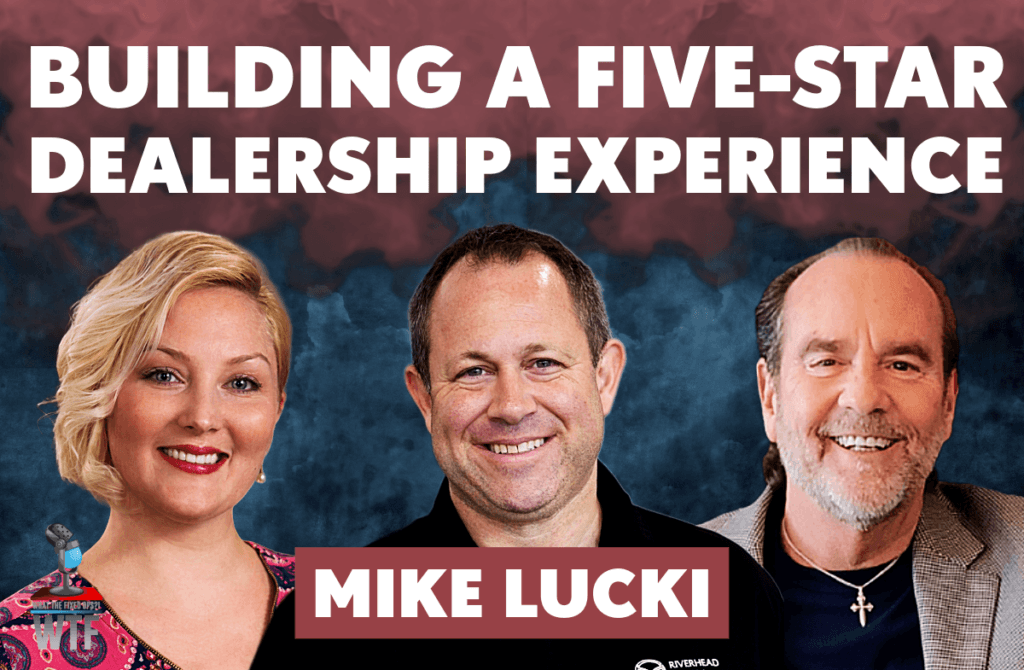
Dealership success is often associated with sales volume, profitability, and customer satisfaction, but creating a consistently outstanding customer experience starts with the people responsible for delivering it. During his appearance on the What the Fixed Ops?! podcast, Mike Lucki, owner of Lucki Mazda of Woodbridge, shared how his experience as a third-generation automotive dealer, NADA Academy instructor, and dealership owner has shaped his approach to leadership and dealership operations. After helping launch two Mazda dealerships from the ground up, Lucki has focused on building teams that deliver five-star customer experiences without relying on excessive staffing or unnecessary expenses. His approach centers on intentional planning, employee retention, team accountability, and creating a workplace where everyone takes ownership of the customer experience.
Lucki’s automotive background began long before he opened his own dealerships. He grew up in a family deeply involved in the automotive business, with his grandfather starting a Ford Lincoln Mercury dealership in eastern Long Island during the 1950s. After spending time in retail, Lucki joined the NADA Academy as an instructor, teaching general managers and dealer principals who wanted to become dealership owners. He spent approximately six years in that role, learning from experienced operators and building relationships with dealership professionals across the country. He explained that every class provided opportunities to learn new approaches, test different ideas, and discover what was working in other dealerships. Those relationships continued to benefit him when he returned to retail, reinforcing the value of continuous learning and collaboration throughout the automotive industry.
One of Lucki’s biggest motivations as a dealership owner has been creating a five-star customer experience. The idea became a major priority after a conversation with his wife, Kefi, while establishing Riverhead Mazda. When Lucki suggested that maintaining a rating above 4.8 stars would be enough to attract customers, she challenged him to aim for a perfect five-star rating instead. Although he initially believed that goal was unrealistic, the dealership eventually built a reputation supported by more than 550 customer reviews. At the time of the podcast recording, Riverhead Mazda had a 4.9-star rating, while the newer Lucki Mazda of Woodbridge location had accumulated more than 170 five-star reviews in approximately four months. For Lucki, those results demonstrated that a five-star experience is possible when the entire team is aligned around the same expectations.
Maintaining that level of customer satisfaction requires more than simply responding to positive reviews. Lucki explained that negative feedback is treated as an opportunity to understand what went wrong, address the customer’s concerns, and identify ways to prevent the same issue from happening again. When a review does not meet expectations, he works with his wife to understand the customer’s perspective and determine the best way to respond. However, resolving an individual complaint is only part of the process. The dealership also looks for solutions that employees can consistently apply in the future. By turning customer feedback into repeatable improvements, dealerships can strengthen their processes while demonstrating that they genuinely value the people they serve.
Delivering a five-star experience with a right-sized dealership team presents its own challenges. Larger dealerships may have specialists and backup employees available when unexpected situations arise, but smaller operations often have fewer people to cover multiple responsibilities. An employee calling in sick, a salesperson being tied up with a customer, or an unexpected rush in the service drive can quickly create delays. Lucki believes smaller dealerships must be especially intentional about staffing and flexibility. Rather than relying on employees to stay within narrow job descriptions, his stores encourage team members to step in wherever help is needed. During busy service periods, that might mean the owner greeting customers, the parts manager assisting in the service drive, or someone from the sales department helping another employee.
Lucki shared an example of this teamwork when one salesperson was struggling to complete a deal. Another salesperson recognized an opportunity to help because she spoke the customer’s language and believed she could better connect with them. She stepped in, worked with the customer, and helped close the sale. Lucki emphasized that this kind of teamwork does not happen simply because a dealership hires good people. It also requires appropriate compensation plans, clearly defined roles and responsibilities, consistent communication, and recognition when employees go above and beyond. When team members see their coworkers being acknowledged for helping others, they are more likely to step up the next time an opportunity arises.
Employee retention is another central part of Lucki’s approach to building a successful dealership. He explained that dealerships often invest time and resources into improving processes, only to lose key employees who understand how those processes work. When that happens, the organization may have to start over, making leaders less willing to pursue additional improvements. To prevent this cycle, Lucki believes dealerships need to focus on attracting the right people, retaining high performers, and creating an environment where employees feel motivated to contribute. He also highlighted the importance of reducing avoidable employee turnover, particularly when strong employees leave for reasons that dealership leadership could have addressed.
In his NADA presentation, Lucki emphasizes the importance of aligning a dealership’s vision, processes, organizational structure, people, inventory, and marketing. These elements need to support one another rather than operate independently. A dealership should first establish a clear vision, then develop the processes required to deliver it, followed by an organizational structure that gives employees the ability to execute those processes. Once those foundations are in place, leaders can identify the people and resources needed to support the business. Without that alignment, even talented employees can struggle when expectations, responsibilities, and operational systems are unclear.
Lucki also advocates for prioritizing employee satisfaction before customer satisfaction and manufacturer or OEM satisfaction. He believes employees need to feel that they matter, that their contributions make a difference, and that they are part of something bigger than their individual responsibilities. When employees feel valued and enjoy coming to work, customers can often recognize that positive environment. A dealership’s culture is reflected in the way people interact with one another, support their coworkers, and approach customer service. As Lucki explained, happy employees make happy customers. Building that environment requires leaders to pay attention to employee needs and create a workplace where people feel respected and included.
Creating an ownership-driven culture is another way Lucki encourages employees to take greater responsibility for dealership performance. He explained that several members of his team previously owned businesses outside the automotive industry. Those experiences helped them understand the importance of managing time, taking care of customers, maintaining facilities, and recognizing problems before they become larger issues. In Lucki’s view, having an owner’s mentality means treating the entire dealership as something you are responsible for, not just focusing on your assigned tasks. If someone sees trash in the parking lot, they pick it up. If a customer needs assistance, they find a way to help. If a process is not working, they speak up and look for a solution.
For employees who have never owned a business, leadership behavior plays an important role in establishing those expectations. Lucki believes employees pay close attention to what managers do, not just what they say. Leaders who take responsibility, listen to employee feedback, and demonstrate genuine concern for the business help establish a culture that others can follow. His dealerships also use daily meetings to discuss challenges, share ideas, and gather feedback from employees. When team members see their suggestions being considered and implemented, they become more invested in the outcome. Lucki also stresses the importance of addressing performance issues privately rather than criticizing employees in front of their coworkers. Accountability is necessary, but it should be handled in a way that supports employee development and preserves trust.
Team accountability is reinforced through compensation plans and shared information. Lucki explained that his dealership uses compensation structures with team-based components, allowing employees to benefit when the overall store achieves its goals. The approach encourages employees to help one another because individual performance can contribute to the success of the entire team. Their CRM system also gives employees visibility into customer interactions, while customer reviews are shared across the organization. When a positive review comes in, the team can recognize the employee responsible. When a negative review appears, employees can work together to understand what happened and determine how to improve. This visibility encourages collaboration and helps prevent customer questions or requests from being overlooked when a particular salesperson or manager is unavailable.
Technology is another important part of improving dealership efficiency, particularly when it comes to reducing repetitive tasks. Lucki believes nearly every department has opportunities to improve, but processes that do not directly involve customers may be among the easiest places to begin. Areas such as accounting, finance and insurance, titling, parts ordering, repair order entry, and technician documentation can benefit from automation and improved systems. However, he cautioned against trying to eliminate the human interactions that make the customer experience meaningful. He shared an example of a salesperson spending three hours helping a customer understand a newly purchased vehicle. Although that interaction took time, the customer appreciated the attention and guidance. In Lucki’s view, technology should create more time for valuable customer interactions rather than replace them.
On the sales side, digital retailing helps create a more efficient and consistent buying experience. Lucki explained that his dealerships use the same digital process in the showroom that customers encounter on the dealership website. Customers can participate in selecting vehicle terms, completing credit applications, and receiving lender approvals through an integrated process. Applications can be sent to multiple lenders, with approvals returning quickly, reducing the need for employees to repeatedly enter the same information or wait through unnecessary steps. By involving customers directly in the process, dealerships can also make the experience feel more transparent and engaging. Lucki noted that reducing perceived wait time can be just as important as reducing the actual time required to complete a transaction.
His approach to vehicle delivery is another example of operational efficiency. Lucki uses a 45-minute target from the time a vehicle is sold to its delivery, with paperwork typically completed faster than the vehicle preparation itself. At Riverhead Mazda, off-site vehicle washing, inspections, and insurance requirements can create additional delays, but the dealership has worked to streamline the steps it can control. The goal is to reduce unnecessary waiting so salespeople can spend more time helping customers and supporting other dealership activities. In the service department, Lucki also highlighted the value of digital inspection videos, which allow customers to see recommended repairs and make decisions more quickly.
When evaluating dealership staffing, Lucki encourages leaders to look beyond how many employees they have and consider how effectively their time is being used. Some positions have periods of intense activity followed by slower stretches throughout the day. Finance and insurance managers, for example, may have several hours when they are not actively working with customers, followed by a few hours when their specialized skills are essential. Rather than leaving that time unused, dealerships can consider additional responsibilities that support the broader organization. Lucki mentioned examples such as inventory management and community involvement, as well as the possibility of finance managers supporting multiple dealerships within a group through remote finance transactions. These approaches can help dealerships make better use of existing talent while maintaining the expertise needed during busy periods.
Ultimately, Mike Lucki’s approach to dealership leadership demonstrates that delivering a five-star customer experience does not necessarily require a larger team or higher personnel costs. It requires a clear vision, aligned processes, the right people, and a culture built around accountability and mutual support. By prioritizing employee satisfaction, reducing avoidable turnover, encouraging ownership, and using technology to eliminate unnecessary work, dealerships can improve efficiency without sacrificing personal customer relationships. His message to automotive leaders is that meaningful progress comes from consistent execution and continuous learning. When dealerships invest in their people and give employees the tools and support to succeed, they create stronger teams, better customer experiences, and a more sustainable foundation for long-term dealership performance.
Read the Transcript
Hey everybody, I’m Russell Hill, your host of WTF and that is what the fixed ops to all of you out there. And I’m joined today by. Hey everyone, I’m Charity, your cohost here and we have Mike lucky on with us today. He’s the owner of Lucky Mazda Woodbridge. Mike, thanks for joining us. Thank you for having me. Yeah. Why don’t you give us a little introduction? Tell us about yourself and what you do. Sure. So as you mentioned, I’m the owner with my wife of Lucky Mazda of Woodbridge, and I grew up in the automotive industry. I’m a third generation automotive dealer. My grandfather started our Ford Lincoln Mercury store in eastern Long Island back in the nineteen fifties. My father, my uncle, my other uncle, my brother in law, my sisters, everyone is part of our family business. Wow. Yeah. So it’s definitely a family business. My sister married really well. She married someone that brought four employees himself. And three of his brothers all work for us up in New York. And then I married someone from the Washington, D.C. area. So about ten years ago, I left New York, and I came down and taught at the Nada Academy. I was an instructor for general managers and dealer principals that wanted to become a dealer principal and wanted to learn how to run dealerships, and I taught there for about six years. From there, I ended up buying a dealership in New York, actually in the same hometown market of where my family, where my family has other stores. It was from one of my students who had just moved to that area and bought a few other stores in that market, and I set up Riverhead, Mazda. Riverhead. Mazda was on the same property as Riverhead, Ford and Riverhead GMC store, but it was just me and a trailer three years ago, moved up to New York and set it up, and now we’re about to move into the new facility. And then about a year and a half in, Mazda came to me and said, you’re doing a great job. Can you open up another store for us in a new market? And that’s where I am here now in Woodbridge, Virginia. So I’ve done a lot in the last three years, setting up two dealerships from from the ground up and delivering it in a way that, as you’ll hear, I think we’re going to talk about how to deliver a five star experience and why that’s important. Well, that is awesome. You mentioned your, your, your wife as a partner with you. What is her name? Because she’s going to be listening to this, I’m sure. I’m sure her name is Kefi. Her full name is Safina, but everyone hears that and they say Stephanie. Stephanie. But it’s not. It’s it’s s e f I. She is the half partial owner of fifty percent owner with me even decision making. And we’re in it for our family and for our business. That’s awesome. Well, hello Kefi glad you got a chance to watch your husband rock and roll in here. We’re excited to have him today. Uh. Go ahead. Jerry. Yeah. Congratulations. That’s such an impressive resume that you have there and a cool family history. And it sounds like you’ve worn a lot of hats and a d a instructor dealer principal. How do you think all that shapes how you run a dealership today? Well, my experience at Nada. It was it was strange for me to join the Nada Academy because at the time I was working in retail and, and the I had just graduated as a student from the Academy about a year before, and I was learning all the different topics. I was implementing them. I looked up to the Academy instructors as in such reverence because they had so much knowledge, so much experience, and they had so much access to everyone around the country that they were teaching. And, and when I got the opportunity to join the team, it was a little bit overwhelming in the beginning. But after a few years, I felt really comfortable in it. And what it did was it allowed me to have access to a lot of different ways to do a similar business, and a lot of different ways to be successful, and learning from the students that I had. So every class that we have, I would learn something new, and then I would test it out in the next class and see if it was effective in the next class. And if I kept on hearing that this was working, then I would go out and learn about it. And when you say you work for nada, the door is open. So it’s really nice to be able to have access to so many intelligent people and really the leaders and leaders in our industry. And if they’ve stayed, I’ve stayed in touch with a lot of my students there. They’ve been very valuable along the journey. You never know when you need someone until you you’re realizing you don’t have a certain position and you have a problem, and then all of a sudden you can call up someone and they say, of course I’ll help you. So the Nada Academy was teaching there, going there as a student, teaching there, and then eventually sponsoring my sister to be a general manager of our store in New York. Uh, was incredible. And it opened up so many doors for me and my career, and I don’t think I’d be where I am without that. That’s exciting. Thank you so much. Yeah, it’s a, uh, it’s just the name itself. It says so much. And the fact that you work for them. Incidentally, you’re also speaking in Ada twenty twenty seven on right sizing your dealership team for a five star customer experience. What inspired you to tackle that particular topic? So I’ll go back to my wife. When we set up Riverhead Mazda, we kept on getting good positive reviews and, and, and, and it was because we, we did a lot of the things I’ll talk about in a little bit. But she said to me, I was like, okay, well, if you don’t have a four point eight or higher, customers are going to not want to go there. And she said, that’s not true. She said, you need to you need a five point oh. And then and then I’ll and then I’ll go there. And I said, that’s impossible. And she’s like, well, you have a five point zero right now. You only have twenty reviews, but you have a five point zero right now. Why can’t you continue it? So fast forward three years. We have over five hundred and fifty reviews and we’re five stars. Wow. In our Riverhead store. Even though at the time when I did the presentation for nada, it was five stars. Now we’re at four point nine and I want to get back to five. So she said, I’m only going to shop somewhere if it’s five stars. And I, and I thought, I thought about our life and I thought about the people that we visit and the services that we use and the schools that we send our kids to and all the things that we that she. And it’s true. And, and why can’t we? And so now in starting up the new store down here in Virginia with her, we’re doing it. We have over one hundred and seventy reviews right now in about four months. And they’re all five stars. If you look us up, we’re five five point oh on Google and even our marketing team that we hired to help us, they said, that’s not going to be possible. They didn’t want to promote it until they saw that it was real. And it is real. So we five stars. I’ll give it to my wife. It was her inspiration. It was her motivation. Whenever we get someone that is not a five star review, we brainstorm how we can overcome it, how we can speak to the person, understand the issue, address the issue, and then improve upon it and learn from it, because it’s never going to be perfect. But people understand, especially if it’s coming from the business owner. So the moment, the moment that we get some feedback, I jump in and I talk to her first because my wife is extremely good with understanding how people are feeling. Just one of her superpowers amongst many others. And she helped me understand why someone feels that way and how to respond to them. But the main way to replicate it is having the right team, but with five stars, because she thought we could do it and we have been able to do it right on Syfy. Yeah. There you go. That’s so cool. Yeah. So you guys really prioritize any kind of negative review that comes in. You address it immediately and you go through and solve that problem. Yes. And we have to solve it in a way that is replicable for our team to do it better the next time we address it. And then we, we figure out a way for it not to happen again. Does that relate to having the right size of team? Because you do say you don’t have to achieve this with a monumental team. Yeah. So that’s the hardest thing. So a lot of people can, can it’s still hard. It’s still hard to deliver a five star experience no matter what you’re trying to do. But in order to do it with a team that is that is not too heavy in terms of personnel cost, in terms of number of people, it can be challenging, especially when a curve ball gets thrown your way. And if you’re in the retail business, you understand that it gets a curve. Ball gets thrown away every single day, every day. So when when someone shows, you know, if someone doesn’t come in because they’re sick or if they have to, they go on a test drive and something happens and they’re not back. And then another customer is sitting there waiting. It’s really hard to do in a small environment. In my opinion. It’s much harder to run a small dealership than a large dealership because a large dealership, you have experts on certain areas and you have a backup and a bench. It’s not easy to do it on a small scale, but we have been able to do it. The difference between the New York store and where I am in Virginia is the New York store was a little bit easier to maintain the experience because we were in a trailer. So when you’re in a trailer in a small space, you can hear every single phone conversation, you can hear, you can see every conversation. So you can jump in and you almost don’t want to jump in sometimes because you’re so close sitting there, you don’t want to jump in because you don’t want to derail the conversation. But if something happens, everyone sees it, everyone knows it. And you’re together in the building that I’m in here, it’s much larger. Even though it’s only been three or four months, and it’s harder to ensure that. So what you have to do is put the right people in place to have the same vision and constantly are watching, correcting and care, as well as having the skill set to do the job. So yeah, it’s hard to do it in a small in a small business, but what we’ve, what we’ve done is, is we, we have people that can fill in when you have the rushes of traffic. So when you have the when you have the the rush of sales traffic at four or five p m on a Saturday, you have to have enough, enough people that can fill in during that time. When you have the Russian service at seven thirty or eight o’clock in the morning of people, you have to have the right people there that can step in and that can sometimes be me. Right. If I if I see that that hour service drive is busy, I’m going to go out and I’m going to meet the customer there. It sometimes can be our porters sometimes can be our parts manager. Our parts consultants sometimes could be in the sales team, our finance manager coming out and being a sales manager. It can be our can be a client advisor doing, uh, helping out another client advisor. We had a customer the other day. I’m just thinking about now as we’re talking about it, the salesperson came to me and said, I can’t seem to make this deal work. And the, the another salesperson was next to me. And she said, I think I can make it work. I said, well, what do you mean? She said, well, I know these people. They’re from. They speak my language and, and I’m going to go in and I think I can make it work. So I said, I’ll go with you. And we went over there and she closed the deal and she helped. So. So why do people help? Because it’s not just it’s not just hiring the right people. It’s having the right compensation plan. It’s having the right roles and responsibilities. It’s having consistent meetings to align with what we’re doing. There’s a lot that goes into it. But when you have someone step up like that and the next morning you recognize it in the team meeting talking about how well she did, going in there and realizing the opportunity and the salesperson that that did sell the car was not her. And she and, and, and that person was so grateful. The next time that happens, people are going to step up. So I guess that was a long answer to your question. Well, it was. Let me tell you, that was awesome. I mean, this is my forty first year in the business. So sixteen of those, I was running stores and now I’m on the vendor side. But I gotta tell you, that is not commonplace. That’s. So you’re going to be a breath of fresh air. I can only imagine that your workshop, the room you’re going to be in, is going to be overflow. They need to hear this. People are craving to hear this kind of stuff because that hasn’t been the norm. And you probably know that, don’t you? Especially being at Nada Academy and all that stuff and being, you know, so on. Right. Well, I’ll tell you, being at the Nada Academy, you see the top of the top, right. The people that are selected to go there are it’s a big investment in time, a big investment in money. You don’t get to go to that program unless you’re sponsored by a dealership that is investing in you. I only saw the top of the top, so I was exposed to incredible dealers that had delivered incredible experiences, and they shared those experiences. Not everyone that was there had that, but I think I didn’t realize it until I left the academy. The, the, the, the difference between the students that I had and their stores and the rest of the industry, the students that I had were, were doing things that were innovative. They were looking. They were open to learning. They were open to new, new development plans. They were the people that I’m seeing now on podcasts like yours and other things that are leading the industry. When you said that, I see a lot of need. I saw a lot, but I saw a lot of good. I saw a lot of excellent operators and people that cared so much about their customers and their teams, and were trying to get better and helping each other. And it was I was so motivational. It made me want to go back into retail and I did, and it made it made me realize how, how good it can be versus reading or seeing things that are posted online about how bad it can be. And, and when I, when I hear some of the statistics about different things of, of, of time, people are waiting and I know it can be fixed because I see people that are fixing it and it’s not easy to do. You have to figure out what to figure out what to work on first. Yeah. No, to answer your question, I saw a lot and I didn’t see I saw a lot of good. Mostly I think there’s more good out there. And and I know that that, uh, dealer principals, general managers, they want that too. Then they listen to somebody like you, which I think are, are following is going to eat up and, and we love and promote this kind of stuff. But, you know, you have to go back and implement and put it into practice and not figure it all out at one time. I do know this successful people do daily what average people do occasionally. So if somebody gets all excited and pumped up and they go back and they don’t execute, they’re going to end up getting the same results, but they need to keep hearing it over and over and over again. You never know when it’s going to hit and when it worked for me, it worked for you. Why can’t it work for everybody else out there? But they got to want it, don’t they, Mike? Yeah. And you know, I have to hear it too. Everyone does. There’s a day you wake up and you’re just feeling a little down. Right? And you and you as the as the owner of the business, you don’t have anyone to go to. You got you got coffee by your side. Right. That. Yeah, that’s that’s definitely true. And I really like that quote. Thank you. I love quote. Yeah, that’s a good one. I think I’m gonna I think I’m going to share it in our meeting tomorrow. Do that. I, I have a lot of, I have a lot of them. Perhaps we’ll maybe even see each other in charities. Also speaking in a day for us this year. So it’s exciting. I look forward to meeting you there in person, probably appearing in your workshop. As a matter of fact. Can you tell everybody when it is Friday, February nineteenth from twelve thirty to one fifteen. I’ll be there. Yeah, well, I better be. Well, tell us a little bit about your presentation. What. Yes. What do you want to hit on? And you know, what do you want people to walk away with it knowing. So so the first thing is most people think deliver a five star experience is going to require more people. It’s going to require more expense. And I don’t think that’s the case. And I want people to understand the, the, the way to go about attracting people to your dealership that feel the same way and are able to deliver that experience and be flexible to learning. And then how to retain those people on the team so you don’t have the number one issue with any type of process changes, employee turnover because you get moving and then all of a sudden you lose a key piece and then you have to do it again. And then eventually you don’t even want to improve things because you are just saying it’s not worth it. So how do you retain those people once you attract them? And then and then how do you motivate them? How do you how do you recognize them? How do you how do you continue that progress of change? How do you identify the turnover that you do have? And how do you eliminate some of the we call it avoidable, dysfunctional turnover. It’s the types of people, the people that are high performers that you could have avoided that turnover. And then how do you have alignment, alignment between your vision, your process, your structure, your people, your inventory and your marketing? And how do you do it from day one? So starting out both businesses, it was very intentional. We started with a vision statement. Then you have your processes to support that vision. Then you have your organizational structure because if you don’t have the right number of people, the processes break down. Yes. Then you then you fill in the right people in that area. But until you have those first three things, you don’t know the people that you’re going to need and who you’re going to be attracting. And then you, then you fill in the inventory and marketing. So actually, I did have to answer that question for my Nada presentation. So let me go back because I said a lot. There were three things they want me to take away. The first is the importance of intentional alignment of your vision, process structure, people, inventory and marketing. Like I just said, that’s the number one thing. Second, um, prioritizing employee satisfaction before customer satisfaction and then before manufacturer or OEM satisfaction. So employee satisfaction, number one, customer satisfaction. Number two OEM manufacturer satisfaction. Number three, in that order, they’re all important, but in that order. And then the third area is ways to limit voluntary dysfunctional, avoidable turnover voluntary dysfunctional, avoidable turnover. I’m so glad you asked me that question because I actually printed it out. Hey, it’s one of your slides. That’s all I gotta tell you though, when I go into a dealership. And so hiring the right people, uh, they, every, I think all of us and everybody that we encounter, they all ultimately want the same thing. Mike. They want to know. They count, they matter. They make a difference. They’re part of something bigger. And they’re not just a number. And when they’re, when they’re when, when you when an organization is that way and you walk in, I don’t care if it’s the sales or the service doesn’t make it, you can feel it, you can feel it. People want to be there. They, they can feel that aura, that vibe, that sense or whatever it is. Happy employees make happy customers. They just do. That’s awesome. It does. What are some of the biggest inefficiencies that you’ve seen in dealership operations that you can address without just hiring more people? Well, technology is supposed to improve efficiency. It’s supposed to. Right, right, right, right. There’s a there’s a quote that Glenn Mercer wrote in his Dealership of Tomorrow study a few years ago, which is that, you know, over I’ll I’ll paraphrase it. But over the last hundred years, technology has improved. But dealerships are pretty much doing the same number of units per salesperson. Hasn’t really improved the overall efficiency of the process at our New York store. And we’re really early on here in Virginia. But our New York store, our salespeople average twenty units per person, and they’re all from outside the automotive industry. They join and we train them on our processes. But we have things that help, right, to be able to do that. We have technology that’s aligned in that in the process. So we use digital retailing in the showroom. So when someone comes in, it’s the same, same experience they have on our website. And then when they come in, they work, work, the deal with the, with the client advisor, client advisor includes the customer in the presentation. They select the terms of the vehicle they want, they press continue, they fill out their credit application. It goes directly to the top three lenders based upon different parameters. And the approval goes right back to them within a minute. So here’s, here’s the savings of time. The sales manager finance manager doesn’t have to input all the information again into a credit application into the tool there. You don’t have to rehash and wait for different banks. Uh, the customer is engaged in that process. So even if it takes a similar amount of time, they’re the ones doing it. So it doesn’t, it’s the perception of time versus the actual time. And then from the moment that they’re approved, it goes right to the next screen, which is the protection product. So they can get an idea of what those protection products are, and they can select one right away if they have questions on them. We have an expert that will go over there and explain that. That’s our finance manager. But the they can select things with the salesperson at the same time. So the speed of the sale is much faster in our New York store. I have a challenge for our. And I’m talking about New York because Virginia is so new. We’re still learning everything. But in our New York store, I usually put a timer down. I say the moment they sold it, let’s deliver the car in forty five minutes or less. And the paperwork is done much faster than the car. The car is the problem in our New York store, because our car wash is off site, and our inspection process in New York and the insurance process takes time, but the paperwork is done much faster. So we’ve really streamlined the process to be very fast. And when it’s fast, the salespeople then have more time to focus on other things. And in the meantime, our sales managers are helping out. One of our core values in New York is every second counts. It’s, it’s we took it from a TV show. Um, but every second counts. And, and they, they joke around because they, they say, what’s going on? Why is this team always seem like they’re running. Uh, they’re always working on something because every second counts and they’re doing it. We’re implementing that down here in Virginia as well, but it’s taking some time because people need to learn the process. And sure, they need to understand the solutions and the product because we came in here, it’s an open point, but we moved into a used car store and we kept the the staff, not all the staff, but we kept most of the staff. And we’re giving them an opportunity to learn our way and our in our culture and the way we do business. So it’s taking a little bit of time to get there. So our units per person is not as high at this store yet. But yeah, that’s one of the ways on the sales side. Um, I also think digital videos do help with time as well in the service department because people can see it, they can approve it faster. So that is something we do with every customer that comes in. Excellent. That sounds a lot like you’ve gotten rid of redundancies and a lot of the repetition that can go with moving from one department to another. Now, I wanted to talk to you a little bit about culture, which you brought up. You talk about building an ownership driven culture, and can you tell us what that looks like on a day to day basis? Yeah. So, so many of our employees were owners of businesses. Oh, and, and, and, and why that’s important is they understand, they understand that the business, everyone has to chip in. And if the, if the floor is dirty, someone goes in and cleans it up. It doesn’t matter who it is. So the owners, like, for example, our service and parts manager owned a bicycle store before he owned it. For thirty years. He had never worked in automotive retail before, but he ran a business. And when you run a business, you know all the things that go into it and you know what it means to take ownership of the process of the of the customer experience. And he is excellent at that as he knows what it takes to run a business. And he can respect how how difficult it is to have all those pieces together. One of our client advisors ran a kitchen supply store in New York City for about twenty years, and she knows what it’s like to have an owner’s mentality. An owner’s mentality means that you own the process. If you see something wrong, you fix it, you go. And if you see something that doesn’t seem right, you address it. Um, because you know what it’s like to own that business. So some of our employees were people that owned their own businesses, are our finance manager in New York owned her own parts supply store before she joined us. So she, she was like, I was a part store, auto parts store. When you have that, that background, it’s a different mentality. And then for the people that don’t have that background, you, they have to know that you care about the business so much. They have to know that when you’re walking around the parking lot, that you’re picking up the trash, even if it’s their job, they have to know that you’re looking out for them, that you’re listening to them. And you might not always do everything that they say, right? Everyone wants something different. But having an owner’s mentality in my mind means that you treat it like it’s your own business and not like every a lot of people say in sales, treat it like it’s your own business, your own clientele. You’re building your book of business. It’s everything. It’s the it’s the facility. It’s your desk. It’s your, it’s your customer. It’s it’s treating treating your coworkers like it’s your business and giving people the ability to talk and provide ideas. And so you don’t, you don’t see that a lot. And people watch more than they actually listen. So I can only imagine. Mike, if you’re out on the lot and a Coke can comes rolling by you and you just, you just step over it. That’s exactly what your take ownership, pick it up. And if they see you do it, then it does reverberate throughout the whole culture. And that’s the kind of stuff you’re talking about. Everybody owns it. Yeah. And since some people have managed large teams before and for whatever reason, they decided to join us and wanted to try this out, and they’re doing great. When you manage a large team of people and you know what it means to organize that and how to hold people accountable to it, it makes a big difference. Well, you have a literally dispersed skill sets with people, the ownerships to not. But working with large teams, people stepping in said, hey, they can do something with it. I think that’s great. You don’t see that a lot. You just don’t. Yeah, yeah. I would also argue that, you know, if you’re gonna argue charity, well, I’d argue maybe the wrong word, but yeah, people who have owned their own businesses before understand, you know, the value of time or the value of a dollar or revenue, you know, they kind of understand, you know, the waste that can happen. Um, and how important to eliminate that. Yeah, absolutely. Yeah, absolutely. Uh, well, let’s see here. Well, tell us, you know, do you have any tricks or advice for getting employees to think like owners? Like how do you get them on the wavelength as you. Yeah, I’ll tell you that. I think the first thing that came to mind was listening to to their ideas and sharing with them the things that are on, on my mind. So every, every day in our, in our meetings every day, right? We have a meeting at eight forty five every day. Eleven forty five every day for the sales team, we have a meeting for service at six thirty in the morning, once per week. But in that meeting, when there’s something that’s on my mind, I get ideas, I get ideas from them, and then they see us implementing them. And I see you see me asking them for feedback. So I think when people see that they’re part of the solution and they’re getting asked for feedback, they take more ownership of that. The other thing is, you know, having standards and holding accountability and people holding people to that. You know, I don’t know what I do. Well, you, you, you actually the first of the three things you talked about earlier in the show about employees. That’s exactly what you do. That’s it’s exactly why in that order that you mentioned it, and those are the things you’re going to be talking about in your workshop. So that’s a. And if people know, they can give feedback. It’s it’s when they stop talking and they start agreeing with anything and everything you say that starts a problem that that is the beginning of a long term problem. If people know they can speak up and they can be heard without the old waiting to respond, but actually listen to understand. Huge, huge. I also find that it’s a quote, right? Not to not to criticize people in public, but to work to work on those things in private. When when things like that happen, you have to address them. When things happen, you have to address them, but you don’t have to address them in front of everyone right at the same time. So you take a take a beat and think about it and figure out how to address it. And I’m always thinking about my team, always thinking about what’s going on. How can I help them do their job better? How, what can I put put in place that they can be successful in their job because they’ll make me successful? They’re the ones. They’re the ones that are doing the job every day. I can’t do everything and I’m always thinking about it is all about the team, right? Together, everyone achieves more. And it is. I love the edifying public and criticize in private if there needs to be constructive criticism anyway. Absolutely. You do it on the. You do it where it’s in earshot of everybody else. Yeah, that doesn’t work very well. But I grew up in an era of retail and cars where that happened, it was common. What’s what’s been interesting when you bring that up about, you know, what’s common is that one of the things that has been interesting, because we don’t have people from the automotive industry in our New York store and the store down here, I have people with automotive experience, but the original part, people, that’s all they knew. There was no, this is not normal. So they had to learn the new normal, right? Yeah. They yeah. They didn’t, they didn’t have that experience of what what it was like or what it is like somewhere else. And the people that did have experience would share that with them. Like, do you know that this is unusual, that you’re, that you’re, that you’re doing these types of things and that you’re engaged and you understand all this and you’re learning such this at a quick time frame and you’re exposed to all of this. And there’s like, no, that seems normal. It seems. Right. So we’ve, we’ve had some people that have thought, you know, this is the way, this is the way every, every dealership does, but then they go on a swap or they go on a DH and they go to another store and they see something happen. Be like. Mike that was strange. This guy just got yelled at in front of me that in front of a customer, this guy just told them, you know, they were like that, that wouldn’t happen here. So it’s creating an expectation of, of the way the business can, you know, can run. Well, let’s hope that person is in your workshop because he or she needs to hear that. Okay. Well, the one, the one, the one who said they were gonna throw a pencil at the person. Yeah. That person. Yeah. Goodness. Well, you, you talked a little bit about accountability. You know, what’s your approach to accountability without having it become micromanaging? Yeah. Team team Accountability. So. So I mentioned that compensation plans have to align with what you expect. Uh, and our compensation plans have team components on them. So, so, and I make sure that people understand that, you know, that if the team hits the goal, then everyone is going to get paid more. It’s going to succeed. So, so every day when you see what the goal is that people are helping each other get there. And when someone doesn’t, uh, doesn’t achieve their part, it hurts the whole team. So, so it’s, and as long as, as long as the, the individual has the drive to work hard and do the, and they learn from each other. Right? They, they see that someone’s doing, uh, doing more than them and not the entire pay plan is based upon, uh, team goals, but a lot of it is so, so team accountability. The other, the other thing is sharing of information. So our CRM system, everyone can see everything and our reviews, when those come in, everyone can see all of them. Excellent. So when someone sees a positive review from someone else and it helps towards the overall store’s goal of having one hundred percent Net Promoter score, and that actually helps their bonus. Then they’re happy, right? Because they see that that, that, you know, that charity did a great job with this customer and they, they’re like, oh, wow, look at that review that that charity just got. Or if we get a one star review, look at that review, that charity just got, what can we do to fix it? And how can we learn from it? And in the CRM, if someone is not answering the questions, then someone else is going to jump in. The managers jump in first. But if the if the managers don’t jump in, we’ll get people coming up to me saying, how would I, how should I answer this? You know, Brian’s out on a test drive with someone. He’s selling a car. He had a customer is asking to buy this car. Do you want me to jump in? And a lot of dealerships. That wouldn’t happen because the salesperson that was out selling the car, they would wait, and that person came back. And you might miss that deal. So the manager should jump in. But if the manager is not available to jump in, we’ll have salespeople jumping in to try to help. How to answer that question, how to make sure that our our queue of phone calls and our queue of text messages and emails is answered. And our technology helps with that because it prioritizes who’s talking to us, which has been a really big benefit. So we’re not overwhelmed with tasks. That’s awesome. Mike, you’ve worked with dealerships in several different capacities from growing up to Nadh. What do you what do most successful dealerships tend to have in common when it comes to leadership? The leaders care. They really do. The people that I see that are the most successful, they care about their people. They care about their customers. They care about their team. It’s just a it’s just a feeling of caring about the business and about about the people that are there. That’s as simple as that. I’m thinking about when it comes to mind, you can have all the technical knowledge in the world, but people will know if you. If you don’t care about it. And it doesn’t have to be a job that you’re doing eighty, ninety hours a week to show that you care. People know that. You know that when when someone’s engaged and the moment that the leader is not engaged is the moment that everyone else feels like they don’t have to be engaged. Absolutely. I heard this a thousand times. Managers light a fire underneath people to get them moving. Leadership’s light a fire inside of people to get them moving, and it becomes their idea and they take ownership of it. And that’s what leadership really is. And apparently you do very well at that. I love it. Thank you. I’m not perfect. Definitely not perfect. It’s about progress, right? It’s about progress, not perfection. Right. Yeah, yeah. Is that right? Is he is he is he continually improving? Yes. I’m sure she’ll say yes. I love it. Um, what departments do you think have um the most opportunity to improve efficiencies in the dealership. All of them. Um but but right right now anything that is not customer facing can probably improve efficiency much faster because of some of the technology that’s coming up. You’re. You’re never going to be able to, in my mind, remove the importance of customer experience and interaction, like the conversations and relating to someone that’s still going to take time. So we could have a customer that wants to spend nine hours with us. That’s okay. Actually, we had a customer buy a car from us and said, I can’t believe your salesperson spent three hours with me showing me how to use the car. That’s not going to go away because you still have to do that. So the things that are going to be made more efficient are going to be the things that I think are not customer experience, customer communication or customer experience items. So things like things like accounting, a lot of the functions in accounting, some of the functions when it comes to finance and insurance and titling, some of the, some of the parts ordering, some of the duplication of, of input on repair orders and even documenting some of the notes for technicians, things like that. But the amount of time it’s going to take to to do the job on the on the technician. And then now the time it’s going to take to talk to a customer until they feel comfortable with what their decision is, that’s not going to change. Some of the finance approvals will get faster. It’s already getting faster in our process. Uh, a lot of automated decision and lending. But this is a business that does take time. Every car sold one at a time, every customer service, one at a time. So I could set up a target that we want to sell one hundred and fifty cars this month, but every one of those requires time, effort, and a connection with someone. That’s right. Absolutely, absolutely. Mike, if a dealer, principal or general manager is listening today, and there’s many of them that are and wanted to evaluate their structure, where where would you recommend they start first? So when dealers were put in a position, like during Covid, when a lot of people had to scale down, they know what the structure could get to because we were put in that position where a lot of dealers had to. I would say, you want to find different jobs for the people that are not always going to be busy during the day. So there are certain jobs that that have a very intense time period where they’re very productive, and then other times when they don’t. So for example, finance and insurance managers. Okay. That’s the one that comes to mind the most for me is that they could have six hours a day where they’re not, uh, doing much and then they could have three hours that are they’re the most important person in the dealership by far. Yeah. And they have a specialized skill set. So. So what do you what do you have? What do you do in the other six hours to be able to continue helping the rest of the team while making sure they’re still sharp and making sure they’re still able to do those three hours exceptionally well? And I’m not doing this yet, but it’s something I’m considering. One of my my friends is doing it at his stores. He has finance manager that are working across his group and doing remote finance turns at different stores that he has. I love it to be able to fill that time in. I know that our finance manager also did a lot of inventory management and also does a lot of community events. So that was part of her strength. And I didn’t think of it as a when I was looking to hire her, but she came up with a lot of community events that we wanted to be a part of. And during the times when she wasn’t as busy, she focused on figuring out how we could be more involved in the community. Love it. That’s great. That’s really cool. And unfortunately, we’re running out of time, Mike, but any final thoughts about your workshop at Nada or anything that we didn’t ask you today that you wish we had? If you haven’t been to nada Show before, you should go. It’s incredible. Everyone in the same spot, all the all the people that are trying to do better in the industry, every vendor in the same spot. You have to maximize your time when you’re there because there’s so much to do. Oh my gosh. You can get lost quick. Yeah. But I think that going to workshops that I’m hopefully you attend my workshop and charities workshop, but what you’ll, what you’ll find is that you’ll, you’ll make good relationships with people there. Um, I would say that continuous learning is the most important thing and Nada provides that at the show as well as at in the Academy. And I’m learning every day from the people that I’m around. So just keep that mindset, keep that mindset. And our industry will do great as long as we, as long as we continuously learn and we keep our people that are the most important. Well, thank you very much, Mike. We really appreciate you coming on and all the the wonderful information you shared. And for all of you out there listening, you’ll know when he’s coming out because you’re the Friday before, you’ll hear his intro and you know he’s coming. You’re going to see all the shorts and you make sure you attend. You like them, you love them, ask questions, engage with them on whatever your favorite podcast channel is because he’s going to be in all of them. So, uh, thanks to all the listeners out there. And, and once again, thank you and Steffy for all that you do and all that you bring to this industry. And it’s going to be an amazing workshop. Thank you so much for your time today. Thank you Mike. You’re welcome. Thanks. Thank you.